Advertisements
Advertisements
प्रश्न
Given:
A = {Natural numbers less than 10}
B = {Letters of the word ‘PUPPET’}
C = {Squares of first four whole numbers}
D = {Odd numbers divisible by 2}.
Find: n(C)
Advertisements
उत्तर
Here,
A= {1, 2, 3, 4, 5, 6, 7, 8, 9}
B = {P, U, E, T}
C = {0, 1, 4, 9}
D = { } or Φ
n(C) = 4
APPEARS IN
संबंधित प्रश्न
State, whether the pair of sets, given below, are equal sets or equivalent sets:
{3, 5, 7} and {5, 3, 7}
State, whether the pair of sets, given below, are equal sets or equivalent sets:
{7, 7, 2, 1,2} and {1, 2, 7}
State, whether the pair of sets, given below, are equal sets or equivalent sets:
{2, 4, 6, 8, 10} and {a, b, d, e, m}
Write the cardinal number of the following set:
A = {0, 1, 2, 4}
Given:
A = {Natural numbers less than 10}
B = {Letters of the word ‘PUPPET’}
C = {Squares of first four whole numbers}
D = {Odd numbers divisible by 2}.
Find: n(D)
State true or false for the following. Correct the wrong statement.
If B = {1, 5, 51, 15, 5, 1}, then n(B) = 6.
State true or false for the following. Correct the wrong statement.
If T ={a, l, a, h, b, d, h), then n(T) = 5
Verify n(A ∪ B ∪ C) = n(A) + n(B) + n(C) – n(A ∩ B) – n(B ∩ C) – n(A ∩ C) + n(A ∩ B ∩ C) for the following sets
A = {1, 3, 5}, B = {2, 3, 5, 6}, C = {1, 5, 6, 7}
In the adjacent diagram, if n(U) = 125, y is two times of x and z is 10 more than x, then find the value of x, y and z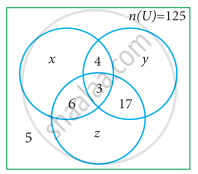
What is the cardinality of an infinite set?
