Advertisements
Advertisements
प्रश्न
Give two examples of vestigial organs in human beings and plants.
Give some examples of vestigial organs.
Advertisements
उत्तर
Vestigial organs are remains of a structure that were functional in some ancestor but is no longer functional in present body.
Some examples of such organs in humans are:
(a) Appendix: The appendix is a small projection of the side of the large intestine near the cecum. It looks kind of like a tail and is found near where the small and large intestines meet. No one knows the actual original function of the appendix.
(b) The tail bone: Attached to the bottom of the sacrum is the coccyx or tailbone. This small, bony projection seems to be a leftover structure of primate evolution. It is believed that human ancestors once had tails and lived in trees. The coccyx would be where the tail was attached to the skeleton.
Some examples of such organs in plants are:
(1) Sexual organs of dandelions: The common dandelion reproduces asexually through a process known as apomixis. However, they still have all of the functional parts that most flowering plants use to reproduce sexually, namely the stamen and pistil.
(2) Grass often has small, undeveloped structures that strongly resemble those of flowering plants.
APPEARS IN
संबंधित प्रश्न
Which of the following pairs of two vegetables represent the correct homologous structures?
(A) Sweet potato and potato
(B) Sweet potato and tomato
(C) Carrot and potato
(D) Radish and carrot
Which of the following is a correct set of homologous organs?
(a) Forelimbs of frog, bird and lizard
(b) Spine of cactus and thorn of bougainvillea
(c) Wings of bat and wings of butterfly
(d) Wings of a bird and wings of a bat
Enlist any four sequential evolutionary names of human ancestors.
The forelimbs of a frog, a bird and a man show the same basic design (or basic structure) of bones. What name is given to such organs?
The organs which perform different functions but have the same basic structure are known as :
(a) homologous organs
(b) analogous organs
(c) homolytic organs
(d) analytic organs
In a class, students were asked to observe the models/slides/pictures of the skeletons of forelimbs and wings of different organisms. After the observations the students made the following groups of homologous structures. Select the correct group :
(A) Wings of a bird and a butterfly
(B) Wings of a pigeon and a bat
(C) Wings of a butterfly and a bat
(D) Forelimbs of a cow, a duck and a lizard
What do we call the degenerated or partially developed useless organs in living organisms? Enlist such organs in human body? How the same organs are useful in other animals?
Vestigial organ ______ present in human body is proof of evolution.
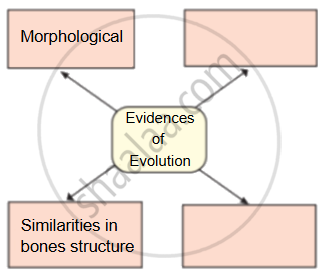
Complete the following chart:
Define phylogeny.
Give scientific reason.
Vertebrates have slowly originated from invertebrates.
Define the evidence of evolution shown in the figure.

Cucurbits do not develop thick and woody stem as they are:
Basic principles of embryonic development were pronounced by:
The process of mating of individuals, which are more closing related than the average of the population to which they belong is called ______.
The presence of gill slits, in the embryos of all vertebrates, supports the theory of ______.
The evolutionary story of moths in England during industrialisation reveals, that 'evolution is apparently reversible'. Clarify this statement.
What is the function of the appendix of our digestive system?
Explain natural selection with the example of industrial melanism.
Complete the following conceptual picture:

