Advertisements
Advertisements
प्रश्न
Gautam had two sticks of equal length. He named them AB and CD. He then placed these two sticks in three different ways and joined their four vertices as shown below.
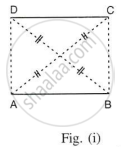
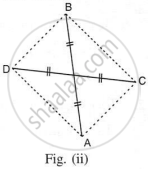
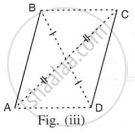
- What type of quadrilateral is in:
- Fig. (i)?
- Fig. (ii)?
- Fig. (iii)?
- What is the sum of consecutive angles in Fig. (iii)?
- If ∠BAD = 70° in Fig. (iii), then what is the measure of ∠CDA?
घटनेचा अभ्यास
Advertisements
उत्तर
-
- Fig. (i): Rectangle (The diagonals are equal in length and bisect each other).
- Fig. (ii): Rhombus (The diagonals bisect each other at right angles).
- Fig. (iii): Parallelogram (The diagonals bisect each other, but are not necessarily equal or perpendicular)
- The sum of consecutive (co-interior) angles in any parallelogram is 180°.
- Since consecutive angles in a parallelogram are supplementary:
∠BAD + ∠CDA = 180°
70° + ∠CDA = 180°
∠CDA = 180° − 70° = 110°
shaalaa.com
या प्रश्नात किंवा उत्तरात काही त्रुटी आहे का?
