Advertisements
Advertisements
प्रश्न
Gas exchange takes place in plants using _____.
पर्याय
Stomata
Chlorophyll
Leaves
Flowers
Advertisements
उत्तर
Gas exchange takes place in plants using stomata.
APPEARS IN
संबंधित प्रश्न
Fig. demonstrates a physiological process taking place in green plants. The whole set-up was placed in bright sunlight for several hours. Study the diagram and answer the questions that follow:
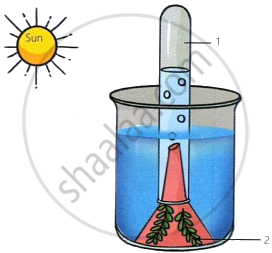
- What aspect of the physiological process is being examined?
- Explain the physiological process mentioned in (a) above.
- Label the parts numbered 1 and 2 in the diagram.
- Write a well-balanced chemical equation for the physiological process explained in (b) above.
- What would happen to the rate of bubbling of the gas if a pinch of sodium bicarbonate is added to the water in the beaker? Explain your answer.
Expand the following biological abbreviations :
ATP
The following statement is about photosynthesis in a green plant. Write whether it is True or False.
Photosynthesis occurs in underground organs as well as in aerial ones.
The specific function of light energy in the process of photosynthesis is to
Name the membrane that connects thylakoid of one granum With the other granum.
How do non-green plants such as fungi and bacteria obtain their nourishment?
Photosynthesis is considered as a process supporting all life on earth.
Choose the correct option.
Energy is transferred from the light reaction step to the dark reaction step by ______.
The role of chlorophyll is to absorb light from the sun.
Mention four factors required for photosynthesis?
