Advertisements
Advertisements
प्रश्न
Find the distance between the following pairs of point.
W `((- 7)/2 , 4)`, X (11, 4)
Advertisements
उत्तर
Let the co-ordinates of point W are (x1, y1) and of point X are (x2, y2)
`((-7)/2,4)` = (x1, y1)
(11, 4) = (x2, y2)
d (W, X) = `sqrt((x_2-x_1)^2+(y_2-y_1)^2)`
= `sqrt((11-(-7/2))^2+(4-4)^2`
= `sqrt((11+7/2)^2+0)`
= `(11 + 7/2)`
= `11/1+7/2`
= `(22+7)/2`
= `29/2`
= 14.5
∴ Distance between points W and X is 14.5.
संबंधित प्रश्न
Find the value of a when the distance between the points (3, a) and (4, 1) is `sqrt10`.
Prove that the points A(1, 7), B(4, 2), C(−1, −1), and D(−4, 4) are the vertices of a square.
Given a triangle ABC in which A = (4, −4), B = (0, 5) and C = (5, 10). A point P lies on BC such that BP : PC = 3 : 2. Find the length of line segment AP.
A(–8, 0), B(0, 16) and C(0, 0) are the vertices of a triangle ABC. Point P lies on AB and Q lies on AC such that AP : PB = 3 : 5 and AQ : QC = 3 : 5. Show that : PQ = `3/8` BC.
Find the distance between the points:
A(7, –4) and B(–5, 1)
Find the distance between the points `A((-8)/5, 2)` and `B(2/5, 2)`.
Find the distances between the following point.
R(–3a, a), S(a, –2a)
The perimeter of a triangle with vertices (0, 4), (0, 0) and (3, 0) is ______.
Find the distance of the following point from the origin :
(13 , 0)
Find the coordinate of O , the centre of a circle passing through A (8 , 12) , B (11 , 3), and C (0 , 14). Also , find its radius.
Prove that the points (7 , 10) , (-2 , 5) and (3 , -4) are vertices of an isosceles right angled triangle.
Find the distance between the origin and the point:
(8, −15)
A point P lies on the x-axis and another point Q lies on the y-axis.
Write the abscissa of point Q.
A point P lies on the x-axis and another point Q lies on the y-axis.
If the abscissa of point P is -12 and the ordinate of point Q is -16; calculate the length of line segment PQ.
Give the relation that must exist between x and y so that (x, y) is equidistant from (6, -1) and (2, 3).
The point which lies on the perpendicular bisector of the line segment joining the points A(–2, –5) and B(2, 5) is ______.
If (a, b) is the mid-point of the line segment joining the points A(10, –6) and B(k, 4) and a – 2b = 18, find the value of k and the distance AB.
What is the distance of the point (– 5, 4) from the origin?
|
In a GPS, The lines that run east-west are known as lines of latitude, and the lines running north-south are known as lines of longitude. The latitude and the longitude of a place are its coordinates and the distance formula is used to find the distance between two places. The distance between two parallel lines is approximately 150 km. A family from Uttar Pradesh planned a round trip from Lucknow (L) to Puri (P) via Bhuj (B) and Nashik (N) as shown in the given figure below.
|

Based on the above information answer the following questions using the coordinate geometry.
- Find the distance between Lucknow (L) to Bhuj (B).
- If Kota (K), internally divide the line segment joining Lucknow (L) to Bhuj (B) into 3 : 2 then find the coordinate of Kota (K).
- Name the type of triangle formed by the places Lucknow (L), Nashik (N) and Puri (P)
[OR]
Find a place (point) on the longitude (y-axis) which is equidistant from the points Lucknow (L) and Puri (P).
|
Tharunya was thrilled to know that the football tournament is fixed with a monthly timeframe from 20th July to 20th August 2023 and for the first time in the FIFA Women’s World Cup’s history, two nations host in 10 venues. Her father felt that the game can be better understood if the position of players is represented as points on a coordinate plane. |
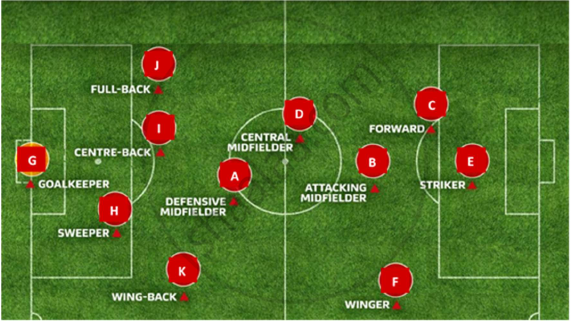
- At an instance, the midfielders and forward formed a parallelogram. Find the position of the central midfielder (D) if the position of other players who formed the parallelogram are :- A(1, 2), B(4, 3) and C(6, 6)
- Check if the Goal keeper G(–3, 5), Sweeper H(3, 1) and Wing-back K(0, 3) fall on a same straight line.
[or]
Check if the Full-back J(5, –3) and centre-back I(–4, 6) are equidistant from forward C(0, 1) and if C is the mid-point of IJ. - If Defensive midfielder A(1, 4), Attacking midfielder B(2, –3) and Striker E(a, b) lie on the same straight line and B is equidistant from A and E, find the position of E.
