Advertisements
Advertisements
प्रश्न
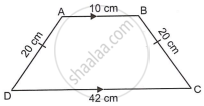
Find the area of isosceles trapezium ABCD where AB = 10 cm, AD = BC = 20 cm and DC = 42 cm.
Advertisements
उत्तर
Given:
- ABCD is an isosceles trapezium.
- AB = 10 cm ...(Top base)
- DC = 42 cm ...(Bottom base)
- AD = BC = 20 cm ...(Equal non-parallel sides)
Step-wise calculation:
1. Let the trapezium be drawn such that AD and BC are the equal sides.
2. Calculate the height (h) of trapezium using Pythagoras theorem by dropping perpendiculars from A and B to the base DC.
The difference in the bases is 42 – 10 = 32 cm.
Half of this difference on each side is `32/2` = 16 cm.
Imagine D to foot of perpendicular from A as x and similarly from B to C as the same length 16 cm isosceles.
3. Using triangle formed by height, side 20 cm and half difference 16 cm:
`h = sqrt(20^2 - 16^2)`
= `sqrt(400 - 256)`
= `sqrt(144)`
= 12 cm
4. The area (A) of trapezium formula:
`A = 1/2 xx (AB + DC) xx h`
Substitute values:
`A = 1/2 xx (10 + 42) xx 12`
= `1/2 xx 52 xx 12`
= 26 × 12
= 312 cm2
The area of the isosceles trapezium ABCD is 312 cm2.
