Advertisements
Advertisements
प्रश्न
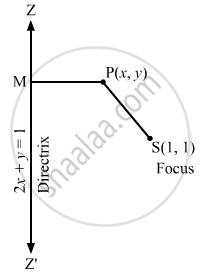
Find the equation of the hyperbola whose focus is (1, 1) directrix is 2x + y = 1 and eccentricity = \[\sqrt{3}\].
Advertisements
उत्तर
Let S be the focus and \[P\left( x, y \right)\] be any point on the hyperbola.
Draw PM perpendicular to the directrix.
By definition:
SP = ePM
\[\Rightarrow\] \[\sqrt{(x - 1 )^2 + (y - 1 )^2} = \sqrt{3}\left( \frac{2x + y - 1}{\sqrt{5}} \right)\]
Squaring both the sides:
\[(x - 1 )^2 + (y - 1 )^2 = 3 \left( \frac{2x + y - 1}{5} \right)^2 \]
\[ \Rightarrow x^2 + 1 - 2x + y^2 + 1 - 2y = \frac{3}{5}\left( 4 x^2 + y^2 + 1 + 4xy - 2y - 4x \right)\]
\[ \Rightarrow 5 x^2 + 5 - 10x + 5 y^2 + 5 - 10y = 12 x^2 + 3 y^2 + 3 + 12xy - 6y - 12x\]
\[ \Rightarrow 7 x^2 - 2 y^2 + 12xy + 4y - 2x - 7 = 0\]
∴ Equation of the hyperbola = \[7 x^2 - 2 y^2 + 12xy + 4y - 2x - 7 = 0\]
APPEARS IN
संबंधित प्रश्न
Find the equation of the hyperbola satisfying the given conditions:
Foci `(0, +- sqrt10)`, passing through (2, 3)
The equation of the directrix of a hyperbola is x − y + 3 = 0. Its focus is (−1, 1) and eccentricity 3. Find the equation of the hyperbola.
Find the equation of the hyperbola whose focus is (0, 3), directrix is x + y − 1 = 0 and eccentricity = 2 .
Find the equation of the hyperbola whose focus is (a, 0), directrix is 2x − y + a = 0 and eccentricity = \[\frac{4}{3}\].
Find the eccentricity, coordinates of the foci, equation of directrice and length of the latus-rectum of the hyperbola .
9x2 − 16y2 = 144
Find the eccentricity, coordinates of the foci, equation of directrice and length of the latus-rectum of the hyperbola .
16x2 − 9y2 = −144
Find the eccentricity, coordinates of the foci, equation of directrice and length of the latus-rectum of the hyperbola .
4x2 − 3y2 = 36
Find the eccentricity, coordinates of the foci, equation of directrice and length of the latus-rectum of the hyperbola .
3x2 − y2 = 4
Find the eccentricity, coordinates of the foci, equation of directrice and length of the latus-rectum of the hyperbola .
2x2 − 3y2 = 5.
Find the equation of the hyperbola, referred to its principal axes as axes of coordinates, in the conjugate axis is 5 and the distance between foci = 13 .
Find the equation of the hyperbola whose vertices are (−8, −1) and (16, −1) and focus is (17, −1).
Find the equation of the hyperbola whose foci are (4, 2) and (8, 2) and eccentricity is 2.
Find the equation of the hyperbola whose vertices are at (0 ± 7) and foci at \[\left( 0, \pm \frac{28}{3} \right)\] .
If P is any point on the hyperbola whose axis are equal, prove that SP. S'P = CP2.
Find the equation of the hyperbola satisfying the given condition :
vertices (± 2, 0), foci (± 3, 0)
Find the equation of the hyperbola satisfying the given condition :
vertices (0, ± 5), foci (0, ± 8)
Find the equation of the hyperbola satisfying the given condition :
vertices (0, ± 3), foci (0, ± 5)
Find the equation of the hyperbola satisfying the given condition :
foci (0, ± 13), conjugate axis = 24
find the equation of the hyperbola satisfying the given condition:
vertices (± 7, 0), \[e = \frac{4}{3}\]
Find the equation of the hyperbola satisfying the given condition:
foci (0, ± \[\sqrt{10}\], passing through (2, 3).
The difference of the focal distances of any point on the hyperbola is equal to
The equation of the hyperbola whose foci are (6, 4) and (−4, 4) and eccentricity 2, is
The foci of the hyperbola 2x2 − 3y2 = 5 are
Find the equation of the hyperbola whose vertices are (± 6, 0) and one of the directrices is x = 4.
Show that the set of all points such that the difference of their distances from (4, 0) and (– 4, 0) is always equal to 2 represent a hyperbola.
Find the equation of the hyperbola with vertices (± 5, 0), foci (± 7, 0)
Find the equation of the hyperbola with vertices (0, ± 7), e = `4/3`
Find the equation of the hyperbola with foci `(0, +- sqrt(10))`, passing through (2, 3)
The locus of the point of intersection of lines `sqrt(3)x - y - 4sqrt(3)k` = 0 and `sqrt(3)kx + ky - 4sqrt(3)` = 0 for different value of k is a hyperbola whose eccentricity is 2.
