Advertisements
Advertisements
प्रश्न
Find the distance from the eye at which a coin of 2 cm diameter should be held so as to conceal the full moon whose angular diameter is 31'.
Advertisements
उत्तर
Let PQ be the diameter of the coin and E be the eye of the observer.
Also, let the coin be kept at a distance r from the eye of the observer to hide the moon completely.
Now,
\[\theta = \frac{\text{Arc}}{\text{Radius}}\]
\[ \Rightarrow \frac{31}{60} \times \frac{\pi}{180} = \frac{2}{\text{Radius}}\]
\[ \Rightarrow\text{ Radius }= \frac{180 \times 60 \times 2 \times 7}{31 \times 22}\]
\[ = 221 . 7\text{ cm or }2 . 217 m\]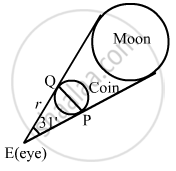
APPEARS IN
संबंधित प्रश्न
Find the degree measure corresponding to the following radian measure (Use `pi = 22/7`)
-4
If in two circles, arcs of the same length subtend angles 60° and 75° at the centre, find the ratio of their radii.
Find the angle in radian through which a pendulum swings if its length is 75 cm and the tip describes an arc of length
10 cm
Find the angle in radian through which a pendulum swings if its length is 75 cm and the tip describes an arc of length
15 cm
Find the degree measure corresponding to the following radian measure:
\[\frac{9\pi}{5}\]
Find the degree measure corresponding to the following radian measure:
\[- \frac{5\pi}{6}\]
Find the degree measure corresponding to the following radian measure:
\[\left( \frac{18\pi}{5} \right)\]
Find the degree measure corresponding to the following radian measure:
1c
Find the radian measure corresponding to the following degree measure: 35°
The difference between the two acute angles of a right-angled triangle is \[\frac{2\pi}{5}\] radians. Express the angles in degrees.
One angle of a triangle \[\frac{2}{3}\] x grades and another is \[\frac{3}{2}\] x degrees while the third is \[\frac{\pi x}{75}\] radians. Express all the angles in degrees.
Find the magnitude, in radians and degrees, of the interior angle of a regular pentagon.
Find the magnitude, in radians and degrees, of the interior angle of a regular octagon.
Find the magnitude, in radians and degrees, of the interior angle of a regular heptagon.
Find the magnitude, in radians and degrees, of the interior angle of a regular duodecagon.
Let the angles of the quadrilateral be \[\left( a - 3d \right)^\circ, \left( a - d \right)^\circ, \left( a + d \right)^\circ \text{ and }\left( a + 3d \right)^\circ\]
We know: \[a - 3d + a - d + a + d + a - 2d = 360\]
\[ \Rightarrow 4a = 360\]
\[ \Rightarrow a = 90\]
We have:
Greatest angle = 120°
Now,
\[a + 3d = 120\]
\[ \Rightarrow 90 + 3d = 120\]
\[ \Rightarrow 3d = 30\]
\[ \Rightarrow d = 10\]
Hence,
\[\left( a - 3d \right)^\circ, \left( a - d \right)^\circ, \left( a + d \right)^\circ\text{ and }\left( a + 3d \right)^\circ\] are
Angles of the quadrilateral in radians =
The number of sides of two regular polygons are as 5 : 4 and the difference between their angles is 9°. Find the number of sides of the polygons.
A rail road curve is to be laid out on a circle. What radius should be used if the track is to change direction by 25° in a distance of 40 metres?
A railway train is travelling on a circular curve of 1500 metres radius at the rate of 66 km/hr. Through what angle has it turned in 10 seconds?
Find the degree measure of the angle subtended at the centre of a circle of radius 100 cm by an arc of length 22 cm.
If D, G and R denote respectively the number of degrees, grades and radians in an angle, the
If the angles of a triangle are in A.P., then the measures of one of the angles in radians is
If the arcs of the same length in two circles subtend angles 65° and 110° at the centre, than the ratio of the radii of the circles is
If OP makes 4 revolutions in one second, the angular velocity in radians per second is
A circular wire of radius 7 cm is cut and bent again into an arc of a circle of radius 12 cm. The angle subtended by the arc at the centre is
Prove that `(sec8 theta - 1)/(sec4 theta - 1) = (tan8 theta)/(tan2 theta)`
If tan θ = `(-4)/3`, then sin θ is ______.
The value of cos1° cos2° cos3° ... cos179° is ______.
State whether the statement is True or False? Also give justification.
Sin10° is greater than cos10°
State whether the statement is True or False? Also give justification.
`cos (2pi)/15 cos (4pi)/15 cos (8pi)/15 cos (16pi)/15 = 1/16`
State whether the statement is True or False? Also give justification.
One value of θ which satisfies the equation sin4θ - 2sin2θ - 1 lies between 0 and 2π.
