Advertisements
Advertisements
प्रश्न
Find the area of the quadrilaterals, the coordinates of whose vertices are
(−3, 2), (5, 4), (7, −6) and (−5, −4)
Advertisements
उत्तर
Let the vertices of the quadrilateral be A (−3, 2), B (5, 4), C (7, −6), and D (−5, −4). Join AC to form two triangles ΔABC and ΔACD.
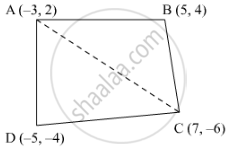
Area of triangle `=1/2{x_1(y_2-y_3) +x_2(y_3-y_1)+x_3(y_1-y_2)}`
Area of ΔABC `=1/2{-3(4+6)+5(-6-2)+7(2-4)}`
`=1/2(-30-40-14)=-42`
∴ Area of ΔABC = 42 square units
Area of ΔACD `=1/2{-3(-6+4)+7(-4-2)-5(2+6)}`
`=1/2 {6-42-40}=-38`
∴Area of ΔACD =38 square units
Area of `square`ABCD= Area of ΔABC+Area of ΔACD
`=`(42+38) square units =80 square units
shaalaa.com
या प्रश्नात किंवा उत्तरात काही त्रुटी आहे का?
