Advertisements
Advertisements
प्रश्न
Fill in the story map given below.
| Title | ______ |
| Setting | ______ |
| Characters | ______ |
| Problems | ______ |
| Your Views | ______ |
Advertisements
उत्तर
| Title | A Day in 2889 of an American Journalist. |
| Setting | The office block of the Managing Editor of the 'Earth Hereld'. |
| Characters | Francis Bennett, Edith Bennett, Cash, Corely, aero-coachman, Two Young men. |
| Problems | They are indifferent to the presence of each new marvel. to them, all seems natural. |
| Your Views | It is futuristic story written in 1889. can they duly appreciate the refinements of civilization in our days? can they understand the advance we have made? |
APPEARS IN
संबंधित प्रश्न
Why did the emperor give her fine gifts?
Where was nagen uncle’s shop?
Identify the character/speaker.
He gave orders for the aged to be put to death.
What is the future of technology?
Find the name of the various UN organization with the logo given below and fill in the blank.

______________________________
______________________________
What kind of news was usually put up on the bulletin board?
What are the little children of Holland, aware of?
Why did the father always say ‘angry waters’?
Identify the character/speaker.
“Tell them to come quickly!”
Solve the crossword using the list of words and the clues.
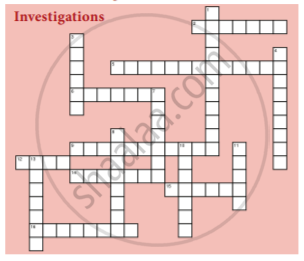
infer observe examine revealed inconceivable aspects link detective inquisitive inspect conclude inquiry analyze mental deduce investigate.
| Across | Down |
| 2. a question | 1. curious; wants to understand things |
| 5. unimaginable | 3. related to the mind |
| 6. to examine all the parts of something in order to understand it. | 4. a person whose job is to find or recognize the hidden information needed to solve a crime |
| 9. to look into a situation (often a crime, but it can also be a mystery. | 7. to look closely at something |
| 12. a connection; one part of a chain | 8. shown or made known |
| 14. to notice or watch | 10. different sides or ways of looking at something |
| 15. to figure out something unknown by considering all its known aspects and reasoning it through | 11. to make a logical guess that something is true based on the evidence, although the evidence is not clear enough to be absolutely certain |
| 16. to consider the evidence and then decide what is true or correct (OR to end something) | 13. to look at something carefully to find problems or specific information |
