Advertisements
Advertisements
प्रश्न
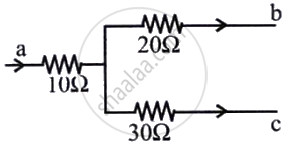
Figure shows a part of an electric circuit. The potentials at points a, b and c are 30 V, 12 V and 2 V respectively. The current through the 20 Ω resistor will be.
पर्याय
0.4 A
0.2 A
0.6 A
1.0 A
Advertisements
उत्तर
0.4 A
Explanation:
Given: Potential at point a (Va) = 30 V
Potential at point b (Vb) = 12 V
Potential at point c (Vc) = 2 V
Let the potential at the central junction point be Vj.
According to Kirchhoff’s Current Law, the sum of currents entering the junction must equal the sum of currents leaving it:
Ia = Ib + Ic ...(i)
Using Ohm’s Law :
I = `(Delta V)/R`
Substituting this value in equation (i), we get,
`(V_a - V_j)/10 = (V_j - V_b)/20 + (V_j - V_c)/30`
⇒ `(30 - V_j)/10 = (V_j - V_b)/20 + (V_j - V_c)/30` ...[Multiply the entire equation by the LCM of denominators (60) to clear them]
⇒ 6(30 − Vj) = 3(Vj − 12) + 2(Vj − 2)
⇒ 180 − 6Vj = 3Vj − 36 + 2Vj − 4
⇒ 180 − 6Vj = 5Vj − 40
⇒ 180 + 40 = 5Vj + 6Vj
⇒ 220 = 11Vj
⇒ Vj = `220/11`
⇒ Vj = 20 V
Now, use the junction potential to find the specific current flowing toward the point.
Ib = `(V_j - V_b)/20`
= `(20 - 12)/20`
= `8/20`
= 0.4 A
