Advertisements
Advertisements
प्रश्न
Figure alongside shows a coil connected to a centre zero galvanometer. The galvanometer shows deflection to the right, when the north pole of a powerful magnet is moved towards right.
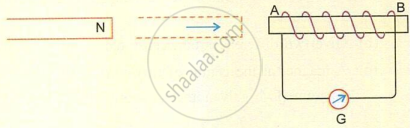
- Explain, why deflection occurs in the galvanometer?
- What is the direction of current when viewed from end A?
- What is your observation in G, when coil AB is moved from N?
- What is your observation in G, when both coil AB and the magnet are moved towards right at the same speed?
सविस्तर उत्तर
Advertisements
उत्तर
- When the magnet moves toward the coil, the magnetic flux (number of magnetic field lines) linked with the coil changes. According to Faraday's law of electromagnetic induction, a changing magnetic flux induces an e.m.f. in the coil. Since the coil is a closed circuit, an induced current flows through it, and this current makes the galvanometer deflect.
- By Lenz's law, the induced current opposes the north pole's approach. Therefore, end A of the coil behaves like a north pole. When viewed from end A (the side from which the magnet is approaching), the induced current flows anticlockwise.
- When the coil AB is moved away from the magnet, the magnetic flux linked with the coil decreases. The induced current now reverses its direction. So the galvanometer needle deflects to the left (opposite to the earlier deflection) while the relative motion continues, and it returns to zero when the motion stops.
- When both the coil AB and the magnet are moved towards the right with the same speed, there is no relative motion between them. The magnetic flux linked with the coil does not change, so no induced current is produced. The galvanometer shows no deflection; it remains at zero.
shaalaa.com
या प्रश्नात किंवा उत्तरात काही त्रुटी आहे का?
