Advertisements
Advertisements
प्रश्न
Explain with the help of a suitable diagram conducting system of human heart.
With the help of a neat and labelled diagram, explain the conducting system of human heart.
Advertisements
उत्तर

- Human heart is myogenic (myo-muscle, genic-originating from). The heart beat originates in modified cardiac muscles called Sinoatrial node (SA node) which lies in the wall of right atrium near the opening of superior vena cava.
- The SA node is called pace maker because it has the power to generate of wave of contraction.
- The wave of contraction of cardiac impulse generated by SA node is conducted by cardiac fibres to both the atria causing their contraction (atrial systole).
- The atrioventricular node (AV node) is located in the wall of right atrium near the opening of coronary sinus and receives the wave of contraction generated by the SA node through internodal pathway.
- The Bundle of His arises from AV nodes and divides into right and left bundle branches located in the interventricular septum.
- The bundle branches give rise to Purkinje fibres which penetrate into myocardium of ventricles. The bundle of His and Purkinje fibres conduct the wave of contraction from the AV node to the myocardium of ventricles causing their contraction (ventricular systole).
संबंधित प्रश्न
Where does blood absorb oxygen?
Name the following:
In embryological stage right and left auricles are communicated by.
Draw the diagram external features of the heart.
State the Function: Semilunar valves of the heart
State the Function: Bundle of His
By which of the following mitral valve and tricuspid valve are attached to the papillary muscles?
Which of the following acts as a pace setter of heart?
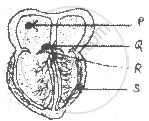
Observe the diagram, Identify the parts labelled as P, Q, R, S. Choose the correct option for the conduction of cardiac impulse.
Valves are present in ______.
When a person suffers from chest pain, the doctor immediately takes an ECG. Visit a doctor and get information about ECG. You may even look up an encyclopaedia or the internet.
