Advertisements
Advertisements
प्रश्न
Explain why there is a need of variety of animals and plants in a forest.
Advertisements
उत्तर १
A greater variety of plants and animals in forests helps them regenerate and grow. A greater variety of plants means more food and habitat for herbivores, and an increase in herbivores means more food for carnivores. Decomposers help maintain the supply of nutrients to the soil and to the growing plants. This wide variety makes forests a dynamic living entity.
उत्तर २
It is necessary to have different types of animals and plants in the forests because –
- We get many important things from animals and plants, such as lac, gum, aromatic substances, honey, medicines, animal feed, biofuel, wool, fur, and food items.
- Plants produce food. All animals, whether vegetarian or non-vegetarian, ultimately depend on plants for food. The organisms that take food from plants are taken as food by other animals. Thus this sequence continues.
Plant → Insect → Frog → Snake → Eagle - Natural balance is maintained by animals and plants.
APPEARS IN
संबंधित प्रश्न
Explain the role of forest in maintaining the balance between oxygen and carbon dioxide in the atmosphere.
List five products we get from forests.
Chipko movement is initiated against ______.
Which of the following canals brought about greenery in Rajasthan?
Amrita Devi Bishnoi sacrificed her life to protect the ______
Who started chipko Andolan?
Which among the following is a major program that was started to replenish the damaged forests?
What is the importance of forest as a resource?
Two friends shared their experiences of their vacation trip to two different forests. Do you think they would have seen the same type of plants and animals during their respective trips? Give reason.
Figure shows a part of a forest.
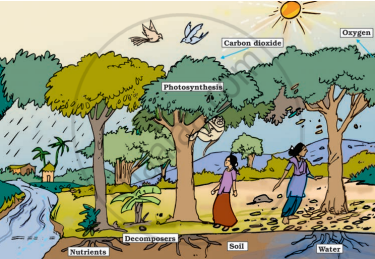
Write any three activities going on in the forest on the basis of this figure.
