Advertisements
Advertisements
प्रश्न
Explain the working of a magnifying glass with a ray diagram.
आकृती
स्पष्ट करा
Advertisements
उत्तर
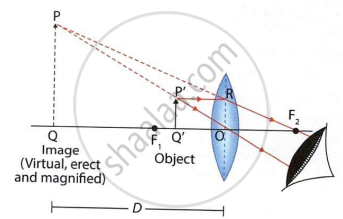
Working Principle:
A magnifying glass (simple microscope) is a single convex lens of short focal length. It works on the principle that when a small object is placed within the focus (between the principal focus F1 and optical center O) of a convex lens, a magnified, virtual, and erect image is produced. When the lens is placed close to the object, it increases the visual angle subtended at the eye, making it easier to identify details.
Ray Diagram Explanation:
- Object (P'Q'): A small object P'Q' is placed vertically on the principal axis within the focal length of the lens.
- First Ray (Parallel): A light ray from point P' travels parallel to the principal axis. After passing through the lens, it refracts at point R and passes through the focus F2 on the other side.
- Second Ray (Optical Center): A second ray from point P' passes directly through the optical center O of the lens and proceeds straight without any deviation.
- Image Formation (PQ): The two refracted rays diverge on the right side where the eye is located. When these diverging rays are produced backward using dashed lines, they intersect at point P. Dropping a perpendicular gives the final image PQ.
Characteristics of the Final Image:
- Nature: Virtual and erect (upright)
- Size: Highly magnified (enlarged)
- Position: Formed at a distance D (least distance of distinct vision) on the same side of the lens as the object.
shaalaa.com
या प्रश्नात किंवा उत्तरात काही त्रुटी आहे का?
