Advertisements
Advertisements
प्रश्न
Explain the types of price elasticity of demand.
Explain the price elasticity with its types.
स्पष्ट करा
Advertisements
उत्तर
Price elasticity of demand is the degree to which the quantity desired of a commodity or service responds to a change in price. Simply said, it indicates how much demand for a product will rise or fall in response to a price change. If a little change in price causes a significant change in demand, the demand is said to be elastic. In contrast, inelastic demand occurs when demand fluctuates very little in response to price changes. Price elasticity enables firms and governments to understand customer behaviour and make pricing, taxing, and production decisions.

- Perfectly Elastic Demand (Ed = ∞): When a slight or zero change in the price brings about an infinite change in the quantity demanded of that commodity, it is called perfectly elastic demand. It is only a theoretical concept. For example, a 10% fall in price may lead to an infinite rise in demand.
Ed = `"Percentage change in Quantity Demanded"/"Percentage change in Price"` = ∞
Ed = ∞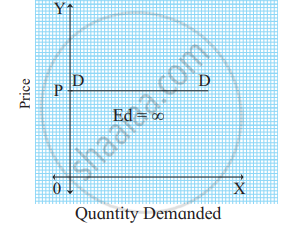
In the figure, the demand curve DD is a horizontal line parallel to the X-axis indicating perfectly elastic demand. - Perfectly inelastic demand (Ed = 0): When a percentage change in price has no effect on the quantity demanded of a commodity it is called perfectly inelastic demand. For example, a 20% fall in price will have no effect on the quantity demanded.
Ed = `(%Delta"Q")/(%Delta"P")`
Ed = `0/20 = 0`
Ed = 0
In practice, such a situation rarely occurs. For example, demand for salt and milk.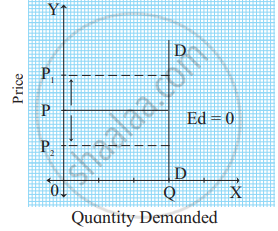
In the figure, when the price rises from OP to OP1 or when the price falls from OP to OP2, demand remains unchanged at OQ. Therefore, the demand curve is a vertical straight line parallel to the Y axis, indicating perfectly inelastic demand. - Unitary elastic demand (Ed = 1): When a percentage change in price leads to a proportionate change in quantity demanded, then demand is said to be unitary elastic. For example, a 50% fall in the price of a commodity leads to a 50% rise in the quantity demanded.
Ed = `(%Delta"Q")/(%Delta"P") = 50/50 = 1`
∴ Ed = 1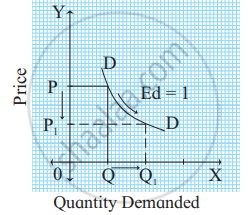
In the figure, when the price falls from OP to OP1 (50%), demand rises from OQ to OQ1 (50%). Therefore, the slope of the demand curve is a 'rectangular hyperbola'. - Relatively elastic demand (Ed > 1): When a percentage change in price leads to more than a proportionate change in quantity demanded, the demand is said to be relatively elastic. For example, a 50% fall in price leads to a 100% rise in quantity demanded.
Ed = `(%Delta"Q")/(%Delta"P")`
Ed = `100/50`
∴ Ed = 2
Ed > 1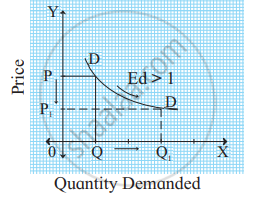
In the figure, when the price falls from OP to OP1 (50%), demand rises from OQ to OQ1 (100%). Therefore, the demand curve has a flatter slope. - Relatively inelastic demand (Ed < 1): When a percentage change in price leads to less than proportionate change in the quantity demanded, demand is said to be relatively inelastic. For example, a 50% fall in price leads to a 25% rise in quantity demanded.
Ed = `(%Delta"Q")/(%Delta"P") = 25/50 = 0.5`
Ed = 0.5
∴ Ed < 1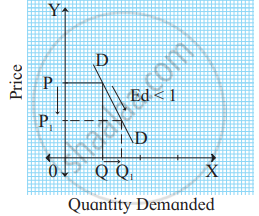
In the figure, when the price falls from OP to OP1 (50%), demand rises from OQ to OQ1 (25%). Therefore, the demand curve has a steeper slope.
shaalaa.com
या प्रश्नात किंवा उत्तरात काही त्रुटी आहे का?
