Advertisements
Advertisements
प्रश्न
Explain the lens action assuming it as a combination of frustum of prisms.
स्पष्ट करा
Advertisements
उत्तर
A lens may be considered as a combination of a large number of frustums of prisms placed side by side. Since a prism always bends a ray of light towards its base, the action of a lens can be explained as follows:
Convex Lens:
- In a convex lens, the bases of all the frustums of prisms are directed towards the principal axis.
- Therefore, each prism bends the incident light ray towards its base.
- As a result, all the parallel rays bend towards the principal axis and meet at the principal focus (F).
- Hence, a convex lens is called a converging lens.
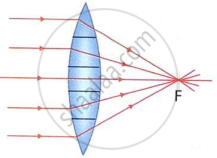
Converging action of a convex lens.
Concave Lens:
- In a concave lens, the bases of all the frustums of prisms are directed away from the principal axis.
- Therefore, each prism bends the incident light ray away from the principal axis.
- As a result, the parallel rays diverge after refraction and appear to come from the principal focus (F) when produced backward.
- Hence, a concave lens is called a diverging lens.
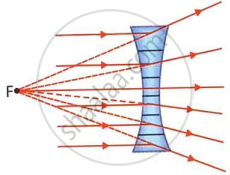
Diverging action of a concave lens.
Thus, the action of a lens can be explained by considering it as a combination of many frustums of prisms. A convex lens converges parallel rays, while a concave lens diverges them.
shaalaa.com
या प्रश्नात किंवा उत्तरात काही त्रुटी आहे का?
पाठ 5: Refraction of Light through Lenses - Intex Question [पृष्ठ ११२]
