Advertisements
Advertisements
प्रश्न
Explain the Law of Equi-Marginal Utility.
State the law of equi-marginal utility.
Advertisements
उत्तर
The law of equimarginal utility states that a consumer allocates his expenditure on various commodities in such a manner that the utility derived from each additional rupee spent on each of the commodities is equal. Algebraically, this is represented as the following equality.
`(MU_x)/(P_x) =(MU_y)/(P_y) = (MU_m)/(P_n) = ...MU_m`
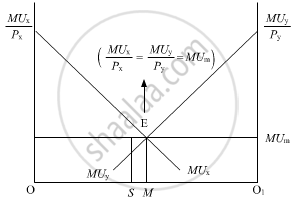
In the above figure, OO1 represents the total income of a consumer. MUx and MUy represent the Marginal Utility curves of commodity x and commodity y, respectively. Point E represents the point of the consumer's equilibrium, where:
`(MU_x)/(P_x) = (MU_y)/(P_y) = MU_m`
At this point, OM amount of income is spent on commodity x and the remaining amount ofincome,e MO1 is spent on commodity y.
APPEARS IN
संबंधित प्रश्न
Explain the relationship between Total utility and Marginal utility.
Answer the following question :
Explain the relationship between ‘total utility’ and ‘marginal utility’.
State whether the following statements are TRUE or FALSE:
In deficit budget, expenditure is more than income.
Fill in the blanks with appropriate alternatives given in the bracket.
Marginal consumption function is always ________.
Fill in the blank with appropriate alternatives given below:
Marginal utility diminishes, as consumption of commodity ________.
Fill in the blank with appropriate alternatives given below:
_________________ utility is the utility derived from the last unit of the commodity consumed.
Fill in the blank with appropriate alternatives given below:
When MU is ______________ TU decreases.
State the following statement is True or False:
MU and TU are equal at the initial stage.
Explain the following concept:
Marginal utility
Give reason or explain:
Utility is ethically neutral.
Answer the following question:
Explain the relationship between TU and MU.
Define marginal utility.
Choose the correct answer from given options
When marginal utility is zero, total utility is
Utility maximising consumers would like to decrease the consumption when ______.
What does total utility (TU) represent?
What is marginal utility (MU)?
