Advertisements
Advertisements
प्रश्न
Explain the structure of chromosomes with labelled diagram.
Advertisements
उत्तर
Structure of chromosome:
- A typical chromosome consists of two chromatids joined together at the centromere also known as primary constriction.
- Primary constriction consists of a disk shape plate called the kinetochore. During cell division, spindle fibers get attached to the kinetochore.
- Apart from primary constriction, a few chromosomes possess an additional one or two constrictions called secondary constriction.
- At secondary constriction I (nucleolar organizer), nucleolus becomes organized during interphase.
- A satellite body (SAT body) is attached at secondary constriction II, in very few chromosomes.
- Each chromatid in turn contains a long, unbranched, slender, highly coiled double-stranded DNA thread, called chromonema, extending through the length of the chromatid.
- The ends of chromosomes (i.e. chromatids) are known as telomeres.
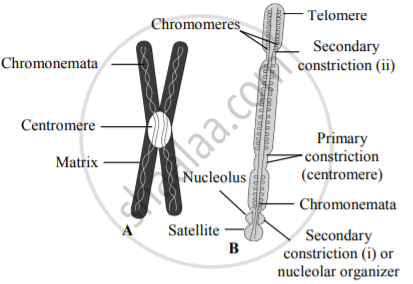
A: Parts of chromosomes
B: Showing secondary constrictions and details
Structure of Chromosome
संबंधित प्रश्न
Chromosomes get aligned at the center of the cell during ______.
Correct the following statement if there is any mistake:
Genes are specific sequences of bases on a chromosome .
Choose the correct answer:
Minimum coiling in chromosome is at ______________
The number of chromosomes in a certain type of cell division is halved. This kind of cell division occurs in ______.
Explain the Term Centrioles
Complete the following sentence with appropriate word :
Chromosomes are _________ material.
Name the following:
A specific part of a chromosome that determine hereditary characteristics.
Write the functional activity of the following structure:
Chromosomes
With the help of a neat labelled diagram, describe the structure of chromosome.
The thin thread-like structures found in the nucleus of each cell are called ______.
