Advertisements
Advertisements
प्रश्न
Explain the spread of the Quite India Movement.
Advertisements
उत्तर
Spread of the movement:
(i) Quit India resolution: Quit India Resolution was passed on 8th August, 1942. ‘Do or Die’ was the slogan of the movement.
(ii) Arrest of the leaders: In the early morning of 9th August, 1942 all the prominent leaders of the Congress including Mahatma Gandhi, Jawaharlal Nehru, Abdul Kalam Azad were arrested and the Congress was banned.
(iii) People’s reaction: The arrests of the leaders worked as a spark. There were hartals and demonstrations all over the country. The government had to face a revolt which was unarmed but most violent in character. Government property was attacked by the people. Communication and transportation systems were totally disrupted. The students took a leading role in the movement. Colleges, universities and schools were closed. The movement was very intense in Bihar, Uttar Pradesh, Assam and Bengal.
संबंधित प्रश्न
The Quit India Resolution in 1942 was one of the final calls given by Gandhi for the British to leave India. Moving towards Independence, Lord Mountbatten’s Plan was significant. In this context, answer the following:
State two reasons for the launching of the Quit India Movement.
The Congress Working Committee passed the famous ‘Quit India Resolution’ at Wardha in July 1942. With reference to this, answer the following questions:
- What were the reasons behind the passing of this resolution?
- What was the British Government's reaction to the Quit India Movement?
- What was the impact and significance of this movement?
Why was the August Offer rejected by the Congress? Give one reason.
Who was selected as the first satyagrahi during the Individual Satyagraha of 1940?
What were the circumstances during the Second World War which forced the National leaders to launch the Quit India Movement?
Who was Stafford Cripps?
What is meant by ‘Mass struggle on non-violent lines’? Which resolution was passed on the 8th of August, 1942 leading to a mass struggle on non-violent lines?
In what way was the Quit India Movement different from earlier movements?
Mention the reasons why the proposals of the Cripps Mission were rejected.
Answer the following: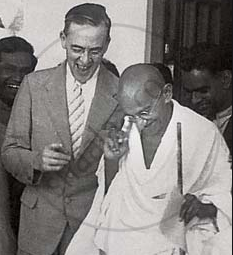
(i) Name the male personality in the picture with Gandhi given alongside.
(ii) Why Britain Prime Minister sent this gentleman to India?
