Advertisements
Advertisements
प्रश्न
Explain the effects of First World War on Austria-Hungar.
Advertisements
उत्तर
Consequences of the First World War on Austria-Hungary: Austria-Hungary was forced to sign a separate treaty (of St. Germain) with the Allies by which she had to accept the following conditions:
(i) Austria-Hungary was broken up and two separate kingdoms of Austria and Hungary were set-up.
(ii) Austria had to cede territories to Czechoslovakia, Yugoslavia and Poland and was forced to accept their independence.
(iii) Italy also gained certain territories (such as Tyrol) from Austria.
(iv) Austrian army was reduced to 30,000.
(v) Austria was also forced to pay a huge-war indemnity.
संबंधित प्रश्न
The War that broke out in 1914 was different from the previous wars in many ways. In this context discuss the following points briefly:
How did the treaty of Versailles seek to cripple Germany’s military strength?
The War that broke out in 1914 was different from the previous wars in many ways. In this context discuss the following points briefly:
What was the territorial rearrangement of Europe as a result of this War?
State any two objections imposed by the Treaty of Versailles on the German military power.
When and between whom was the Treaty of Versailles singed?
How many major powers were there at the end of the 19th Century?
Which country emerged as the Super Power after the War?
Or
The USA emerged as the Super Power after the War. Why?
Describe any four aims of the peace programme of Woodrow Wilson.
Answer the following: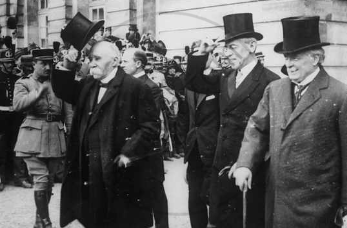
(i) Name the three gentlemen in the picture.
(ii) With which settlement they were associated.
|
The final act of the long-drawn-out negotiations took place at Versailles on Saturday afternoon and to-day Germany and the Allies - always with the exception of America - are at peace. Peace is a blessed word and both the word and the fact are welcome to-day. So far as Germany is concerned, there is for the present, an end of strife and at least a formal return to the decent relations of civilised states. Editorial: Peace in force (12 January 1920) The Guardian |
Name the organization which was established in 1920 to maintain peace after this war.
|
The final act of the long-drawn-out negotiations took place at Versailles on Saturday afternoon and to-day Germany and the Allies - always with the exception of America - are at peace. Peace is a blessed word and both the word and the fact are welcome to-day. So far as Germany is concerned, there is for the present, an end of strife and at least a formal return to the decent relations of civilised states. Editorial: Peace in force (12 January 1920) The Guardian |
Mention any four clauses of the Treaty which affected Germany.
