Advertisements
Advertisements
प्रश्न
Explain different types of elements present in phloem.
Advertisements
उत्तर
Phloem consists of following four elements:
(i) Sieve tubes: These are slender, tube-like structures composed of elongated thin walls placed end to end. Their end walls, sieve plate, are perforated by large number of pores. Sieve tube elements lack nuclei, but they remain alive via adjacent companion cells.
(ii) Companion cells: They are connected with the sieve tubes via plasmodesmata. They are thin-walled cells consisting of dense and active cytoplasm and large, elongated nucleus.
(iii) Phloem parenchyma: As the name suggest, they consist of living parenchyma cells. They are involved in storage and lateral conduction of food.
(iv) Phloem fibres or bast fibres: These are dead cells of phloem possessing a narrow lumen. They are meant for providing mechanical support to the phloem.
APPEARS IN
संबंधित प्रश्न
Name the tissue that transports food in plants.
Name the regions in which parenchyma tissue is present.
Give two functions of collenchyma.
Write a short note on sclerenchyma.
Study the diagram given below and then answer the question that follows:
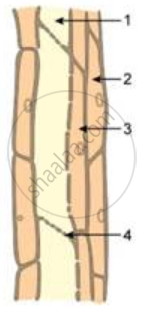
Where is this tissue likely to be found in the plant?
Study the diagram given below and then answer the question that follows:
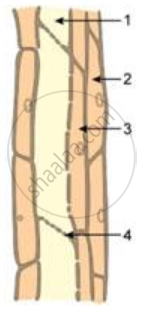
State the function of the parts labelled 1, 2, 3 and 4.
Write 'True or False' for the following statement:
Sclerenchyma cells have intercellular spaces.
Write 'True or False' for the following statement:
A vascular bundle conducts prepared food only.
Differentiate fibers from sclereids.
Cells of this tissue are living and show angular wall thickening. They also provide mechanical support. The tissue is ______.
