Advertisements
Advertisements
प्रश्न
Explain aggregate supply with the help of a diagram.
आकृती
दीर्घउत्तर
Advertisements
उत्तर
- Aggregate supply function is an increasing function of the level of employment.
- Aggregate supply refers to the value of the total output of goods and services produced in an economy in a year.
- In other words, aggregate supply is equal to the value of national product, i.e., national income.
- Aggregate Supply = C + S + T + Rf = Aggregate income generated in the economy.
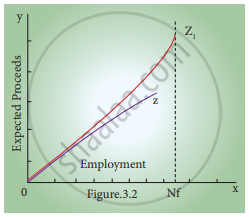
- The following figure shows the shape of the two aggregate supply curves drawn for the assumption of fixed money wages and variable wages.
Aggregate Supply Curve
- Z curve is linear where money wages remain fixed; Z<sub>1</sub> curve is non – linear since the wage rate increases with employment.
- When the full employment level of Nf is reached it is impossible to increase output by employing more men.
- So aggregate supply curve becomes inelastic (Vertical straight line).
- The slope of the aggregate supply curve depends on the relation between employment and productivity.
- Based upon this relation, the aggregate supply curve can be expected to slope upwards.
- In reality, the aggregate supply curve will be like Z1
- Therefore, the aggregate supply depends on the relationship between price and wages.
shaalaa.com
या प्रश्नात किंवा उत्तरात काही त्रुटी आहे का?
