Advertisements
Advertisements
प्रश्न
Examine the table. (Each figure is divided into triangles and the sum of the angles deduced from that.)
| Figure |  |
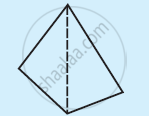 |
 |
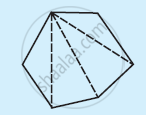 |
| Side | 3 | 4 | 5 | 6 |
| Angle sum | 180° |
2 × 180° = (4 − 2) × 180° |
3 × 180° = (5 − 2) × 180° |
4 × 180° = (6 − 2) × 180° |
What can you say about the angle sum of a convex polygon with number of sides?
a) 7
b) 8
c) 10
d) n
Advertisements
उत्तर
From the table, it can be observed that the angle sum of a convex polygon of nsides is (n −2) × 180º. Hence, the angle sum of the convex polygons having number of sides as above will be as follows.
(a) (7 − 2) × 180º = 900°
(b) (8 − 2) × 180º = 1080°
(c) (10 − 2) × 180º = 1440°
(d) (n − 2) × 180°
संबंधित प्रश्न
Draw rough diagram to illustrate the following Open curve .
Draw rough diagram to illustrate the following Closed curve .
Classify the following curve as open or closed:

Classify the following curve as open or closed:

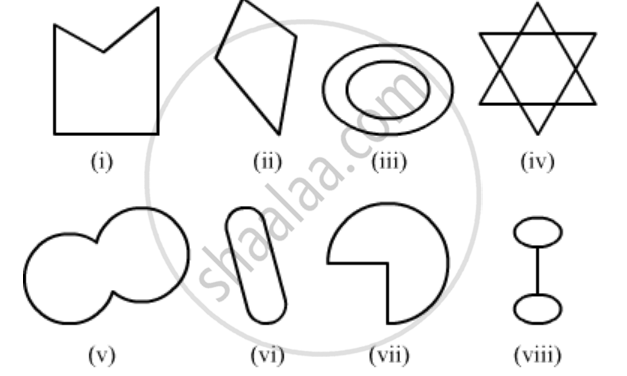
Following are some figures: Classify each of these fugures on the basis of the following:
(i) Simple curve
(ii) Simple closed curve
(iii) Polygon
(iv) Convex polygon
(v) Concave polygon
(vi) Not a curve
What is the sum of all angles of a hexagon?
The measure of each angle of a regular pentagon is ______.
A nonagon has ______ sides.
 is a concave pentagon.
A regular pentagon ABCDE and a square ABFG are formed on opposite sides of AB. Find ∠BCF.
