Advertisements
Advertisements
प्रश्न
Epidermal cells are often modified to perform specialized functions in plants. Name some of them and the function they perform.
Advertisements
उत्तर
- Root Hair: It increases the surface area for absorption of water and minerals from the soils
- Trichomes: They are also known as stem hairs. They help in water loss prevention during transpiration.
- Bulliform cells: Bulliform cells are present in grasses. They help in closing the stomata under stressful conditions and this prevents water loss.
APPEARS IN
संबंधित प्रश्न
In Gymnosperms, the activity of sieve cells are controlled by ______.
Grafting is successful in dicots but not in monocots because the dicots have ______.
Specialised epidermal cells surrounding the guard cells are called
Cuticle is secreted from
Trichomes are ______.
Match the following and choose the correct option from below
| Column I | Column II |
| A. Cuticle | i. Guard cells |
| B. Bulliform cells | ii. Single layer |
| C. Stomata | iii. Waxy layer |
| D. Epidermis | iv. Empty colourless cell |
Identify the simple tissue system from the following.
What is present on the surface of the leaves which helps the plant prevent loss of water but is absent in roots?
Below is a list of plant fibres. From which part of the plant these are obtained
Cotton
Plants require water for their survival. But when watered excessively, plants die. Discuss.
Distinguish between the following:
Stem hair and root hair
What is the stomatal apparatus?
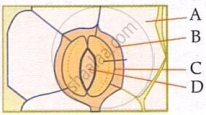
In the given figure, which component has thin outer walls and highly thickened inner walls?
Identify the correct statements:
- Lenticels are the lens-shaped openings permitting the exchange of gases.
- Bark formed early in the season is called hard bark.
- Bark is a technical term that refers to all tissues exterior to vascular cambium.
- Bark refers to periderm and secondary phloem.
- Phellogen is single-layered in thickness.
Choose the correct answer from the options given below:
