Advertisements
Advertisements
प्रश्न
Enlist the characteristics of genetic code.
Describe any three characteristics of the genetic code.
Enlist the four characteristics of the genetic code.
Write any six characteristics of genetic code.
Advertisements
उत्तर
- Genetic code is a triplet code: A sequence of three consecutive bases constitutes a codon, which specifies one particular amino acid. Base sequence in a codon is always in 5’ → 3’ direction. In every living organism, the genetic code is a triplet code.
- Genetic code has distinct polarity: Genetic code shows definite polarity, i.e., direction. It is always read in 5’ → 3’ direction and not in 3’ → 5’ direction. Otherwise, the message will change, e.g., 5’ AUG 3’.
- Genetic code is non-overlapping: Code is non-overlapping, i.e., every single base is a part of only one codon. Adjacent codons do not overlap.
- Genetic code is commaless: There is no gap or punctuation mark between successive/consecutive codons.
- Genetic code has degeneracy: Usually, a single amino acid is encoded by a single codon. However, some amino acids are encoded by more than one codon. e.g., Cysteine has two codons, while isoleucine has three. This is called the degeneracy of the code. The degeneracy of the code is explained by the Wobble hypothesis. Here, the first two bases in different codons are identical, but the third one varies.
- Genetic code is universal: In most living organisms, the specific codon specifies the same amino acid. e.g., Codon AUG always specifies the amino acid methionine.
- Genetic code is non-ambiguous: The specific amino acid is encoded by a particular codon. Alternatively, two different amino acids will never be encoded by the same codon.
- Initiation codon and termination codon: AUG is always an initiation codon in any and every mRNA. AUG codes for the amino acid methionine. Out of 64 codons, three, viz., UAA, UAG, and UGA, are termination codons that terminate or stop the process of elongation of a polypeptide chain, as they do not code for any amino acid.
- Codon and anticodon: A codon is a part of DNA, e.g., AUG is a codon. It is always represented as 5’ AUG 3’. Anticodon is a part of tRNA. It is always represented as 3’ UAC 5’.
Notes
Students should refer to the answer according to their questions.
APPEARS IN
संबंधित प्रश्न
What is degeneracy of genetic code?
Short Answer Question:
Identify the labeled structures on the following diagram of translation.

- Part A is the _______
- Part B is the _______
- Part C is the _______
How t-RNA act as an adapter molecule?
Explain in detail with the help of a diagram.
Draw a neat and labelled diagram of transcription and processing of hn-RNA
Explain in short.
Mutation
Exon part of mRNAs codes for ______
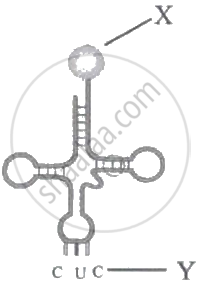
What does 'X' and 'Y' represent in the following diagram oft-RNA molecule?
If there are 300 bases in an RNA which codes for a protein with 100 amino acids, and a base at position 162 is deleted such that the length of RNA become 299, how many codons will be altered.
Given,
Transcription (eukaryotic) : Nucleus; similarly, Transcription (prokaryotic) : ______ ?
Choose the correct option.
DNA is not involved directly in the synthesis of______.
