Advertisements
Advertisements
प्रश्न
Draw two circles with radii 2.5 cm and 4 cm and with their centres 7 cm apart.
Draw a direct common tangent and a transverse common tangent. Calculate the length of the direct common tangent.
Advertisements
उत्तर
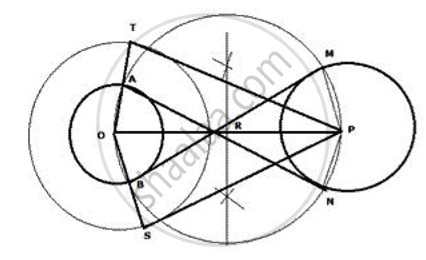
Steps of construction of transverse common tangent:
(i) Draw a line OP= 7 cm.
(ii) At O, draw a circle of radius 2. 5 cm.
(iii) At P, draw a circle of radius 4 cm.
(iv) At O, draw a third circle concentric to the smaller circle and radius= (2.5 + 4) cm= 6.5 cm
(v) Draw a perpendicular bisector of OP. Let R be the mid-point of OP.
(vi) With Ras centre and OR as radii, draw a fourth circle. Mark as T and S where the third and fourth cireles intersect each other.
(vii) Join OT and OS to meet the smaller circle at A and B.
(viii)Join PT and PS.
(ix) On PT and PS, draw perpendiculars to meet the bigger circle at Mand N.
(x) Join AM and BN.
AM and BN are the required tangents.
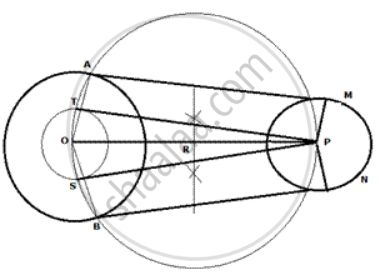
Steps of construction of direct common tangent:
(i) Draw a line OP= 7 cm.
(ii) At O, draw a circle of radius 4 cm.
(iii) At P, draw a circle of radius 2.5 cm.
(iv) At O, draw a third circle concentric to the bigger circle and radius = ( 42.5) cm= 1.5 cm
(v) Draw a perpendicular bisector of OP. Let R be the mid-point of OP.
(vi) With Ras centre and OR as radii, draw a fourth circle. Mark as T and S where the third and fourth cireles intersect each other.
(vii) Join OT and OS and extend lines to meet the bigger cir de at A and B.
(viii) Join PT and PS.
(ix) On PT and PS, draw perpendiculars to meet the smaller circle at M and N.
(x) Join AM and BN.
AM and BN are the required tangents.
On measuring, AM= BN = 7 cm.
APPEARS IN
संबंधित प्रश्न
Draw a right triangle ABC in which AB = 6 cm, BC = 8 cm and ∠B = 90°. Draw BD perpendicular from B on AC and draw a circle passing through the points B, C and D. Construct tangents from A to this circle.
Construct a tangent to a circle of radius 4 cm from a point on the concentric circle of radius 6 cm and measure its length. Also verify the measurement by actual calculation.
Draw a circle of radius 3.5 cm. Mark a point P outside the circle at a distance of 6 cm from the centre. Construct two tangents from P to the given circle. Measure and write down the length of one tangent.
Draw a circle of radius 3 cm. Form a point P, 7 cm away from the centre of the circle, draw two tangents to the circle. Also, measure the lengths of the tangents.
Draw a circle with the help of a bangle. Take any point P outside the circle. Construct the pair of tangents from the point P to the circle.
Draw a pair of tangents to a circle of radius 3 cm, which are inclined to each other at an angle of 60°.
Draw a circle with centre O and radius 2.5 cm. Take a point P at a distance of 6 cm from the centre. Using ruler and compasses only construct the tangents to the circle from the point P.
A pair of tangents can be constructed from a point P to a circle of radius 3.5 cm situated at a distance of 3 cm from the centre.
A pair of tangents can be constructed to a circle inclined at an angle of 170°.
Draw a circle of radius 4 cm. Construct a pair of tangents to it, the angle between which is 60º. Also justify the construction. Measure the distance between the centre of the circle and the point of intersection of tangents.
