Advertisements
Advertisements
प्रश्न
Draw an inscribing circle of a regular hexagon of side 5.8 cm.
Advertisements
उत्तर
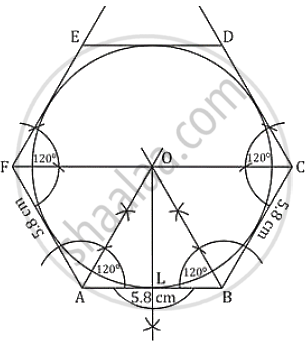
Steps of construction:
- Draw a line segment AB = 5.8 cm.
- At A and B, draw rays making an angle of 120° each and cut off AF = BC = 5.8 cm.
- Again F and C, draw rays making an angle of 120° each and cut off FE = CD = 5.8 cm.
- Join DE. Then ABCDEF is the regular hexagon.
- Draw the bisectors of ∠A and ∠B intersecting each other at O.
- From O, draw OL ⊥ AB.
- With centre O and radius OL, draw a circle which touches the sides of the hexagon.
This is the required in circle of the hexagon.
APPEARS IN
संबंधित प्रश्न
Draw a line AB = 5 cm. Mark a point C on AB such that AC = 3 cm. Using a ruler and a compass only, construct:
- A circle of radius 2.5 cm, passing through A and C.
- Construct two tangents to the circle from the external point B. Measure and record the length of the tangents.
Draw a circle of diameter 9 cm. Mark a point at a distance of 7.5 cm from the centre of the circle. Draw tangents to the given circle from this exterior point. Measure the length of each tangent.
Draw a circle of radius 5 cm. Draw two tangents to this circle so that the angle between the tangents is 45°.
Construct a triangle ABC in which base BC = 5.5 cm, AB = 6 cm and ∠ABC = 120°.
- Construct a circle circumscribing the triangle ABC.
- Draw a cyclic quadrilateral ABCD so that D is equidistant from B and C.
Draw two circles of radii 2.5 cm and 3.5 cm respectively so that their centres are 8 cm apart. Draw direct comm on tangents to the circle.
Draw a circle of radius 4 cm. Take a point P outside the circle without using the center at the circle. Draw two tangents to the circle from point P.
You are given a circle with radius ‘r’ and center O. You are asked to draw a pair of tangents which are inclined at an angle of 60° with each other. Refer to the figure and select the option which would lead us to the required construction. d is the distance OE.

A pair of tangents can be constructed to a circle inclined at an angle of 170°.
Construct a pair of tangents to a circle of radius 3 cm which are inclined to each other at an angle of 60°.
Construct a pair of tangents to a circle of radius 4 cm from a point P lying outside the circle at a distance of 6 cm from the centre.
