Advertisements
Advertisements
प्रश्न
Draw a neat two ray diagram for the formation of images in two plane mirrors, when mirrors are at facing each other.
Advertisements
उत्तर
When two mirrors are parallel to each other

Consider two plane mirrors XY and PQ facing each other and ‘A’ as an object situated anywhere between them (See figure).
It is clear that mirror XY forms its image in mirror PQ and vice versa. These images by themsleves will act as image mirror or virtual mirrors.
Let us consider the normal incidence towards the mirror XY for object A. First of all an image X1 is formed as far behind, as the object is in front of it. This image X1 will fall in front of mirror PQ, and hence, forms an image X2. The image X2 falls in front of mirror XY and hence, forms an image X3. Thus, it continues and infinite images can be formed.
Similarly, taking normal incidence for mirror PQ image P1,P2, P3 etc. are formed.
In order to draw ray diagram, from point A, draw a divergent beam, meeting mirror PQ at points 1 and 2. With P1 as a reference point, draw rays 1, 3, and 2, 4 meeting mirror XY. With P3 as reference point draw rays, such that they enter the eye.
APPEARS IN
संबंधित प्रश्न
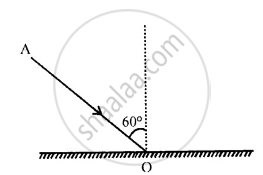
The diagram in fig. shows an incident ray AO and the normal ON on a plane mirror. Draw the reflected ray. State the law you use to draw the direction of the reflected ray.
What is meant by lateral inversion of an image in a plane mirror? Explain it with the help of a ray diagram.
The image formed by a plane mirror is :
Two plane mirrors are placed making an angle 60° in between them. For an object placed in between the mirrors, the number of images formed will be :
An object is placed (i) asymmetrically (ii) symmetrically, between two plane mirrors inclined at an angle of 50°. Find the number of images formed.
State the mirror formula for the formation of total number of images formed in two plane mirrors, held at an angle.
Draw a neat two ray diagram for the formation of images in two plane mirrors, when mirrors are at right angles to each other.
A boy stands 4 m away from the plane mirror. If the boy moves `1/2` m towards the mirror, what is now the distance between the boy and his image? Give a reason for your answer.
Write down the letters of the word ‘POLEX’ as seen in a plane mirror, held parallel to the plane of this paper.
Select the correct option:
If an incident ray passes through the centre of curvature of a spherical mirror, the reflected ray will:
