Advertisements
Advertisements
प्रश्न
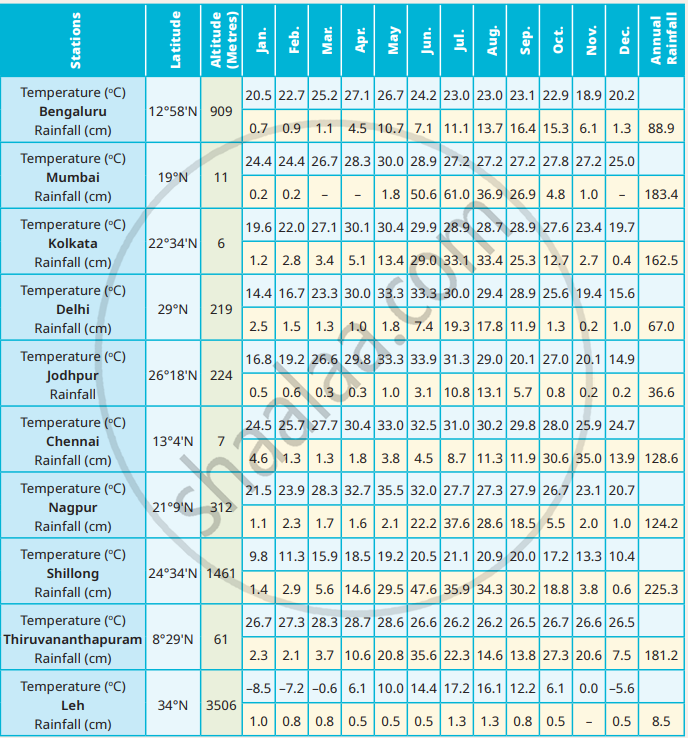
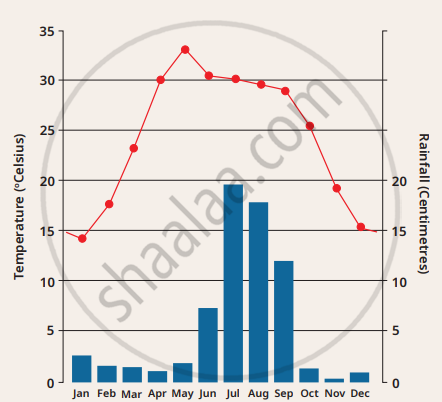
| Do it yourself: Table shows the average monthly temperatures and rainfall amounts for 10 representative stations. Study these figures on your own and convert them into ‘temperature and rainfall’ graphs. The visual representations will help you grasp their similarities and differences at a glance. One such graph, Fig., is already prepared for you. See if you can arrive at some broad generalisations about our diverse climatic conditions. |
1. Now look at the table again. Rearrange the 10 stations according to their distance from the equator.
2. Find out:
- Two stations with the most extreme climate
- Two stations influenced by retreating monsoons.
- The two hottest stations in the months of
- February
- June
3. Now find out:
- Why does Shillong experience more rainfall than Kolkata?
- Why does Delhi receive more rainfall than Jodhpur?
4. Now think about why
- Thiruvananthapuram has an equable climate?
- Chennai has more rainfall only after the fury of the monsoon is over in most parts of the country?
- Leh has moderate precipitation almost throughout the year?
5. Despite these differences across regions, can you observe any substantial evidence to conclude that the monsoons provide a very strong framework, lending overall climatic unity to the whole country?
सविस्तर उत्तर
Advertisements
उत्तर
1.
- Thiruvananthapuram: 8°29' N
- Bengaluru: 12°58' N
- Chennai: 13°4' N
- Mumbai: 19°N
- Nagpur: 21°9' N
- Kolkata: 22°34' N
- Shillong: 24°34' N
- Jodhpur: 26°18' N
- Delhi: 29°N
- Leh: 34°N
2. a. Two stations with the most extreme climate
- Leh: Extreme cold desert conditions, dropping to -8.5°C in January.
- Jodhpur or Delhi: High summer temperatures (33.3°C) combined with dry or semi-arid conditions.
b. Two stations influenced by retreating monsoons
- Chennai: Receives its highest rainfall in October (30.6 cm) and November (35.0 cm).
- Thiruvananthapuram: Receives substantial late-season rainfall extending into October and November.
c.
- The two hottest stations in February
- Thiruvananthapuram: 27.3°C
- Chennai: 25.7°C
- The two hottest stations in June
- Nagpur: 35.5°C
- Jodhpur: 33.9°C
3. a.
- Relief features: Shillong is located in the Khasi Hills.
- Funneling effect: The hills trap the moist Bay of Bengal branch of the monsoon.
- Orographic lift: This causes intense, heavy precipitation compared to the flat plains of Kolkata.
b.
- Monsoon path: Delhi lies further east and receives moisture from both the Bay of Bengal and Arabian Sea branches.
- Aravalli range: Jodhpur lies to the west of the Aravalli hills, which run parallel to the Arabian Sea monsoon winds, preventing cloud condensation and leaving the region arid.
4.
- Thiruvananthapuram is situated near the sea. The moderating influence of the Arabian Sea keeps temperatures fairly uniform throughout the year, resulting in an equable climate.
- Chennai receives most of its rainfall during the north-east (retreating) monsoon during October and November. At this time, winds pick up moisture from the Bay of Bengal and bring rainfall to the Coromandel Coast.
- Leh is located in a high-altitude cold desert region. It receives little but fairly uniform precipitation throughout the year because it lies in the rain-shadow region of the Himalayas, where moisture-bearing winds cannot reach easily.
5. Yes, the monsoon provides climatic unity to India. Although temperature and rainfall vary from region to region, most parts of the country receive rainfall due to the seasonal monsoon winds. Agriculture, water resources, and the daily lives of people largely depend on the monsoon. Thus, the monsoon acts as a common climatic factor that links different regions of India and gives the country a sense of climatic unity.
shaalaa.com
या प्रश्नात किंवा उत्तरात काही त्रुटी आहे का?
