Advertisements
Advertisements
प्रश्न
Discuss the factors affecting the climate of Brazil.
Write about the factors affecting the climate of Brazil.
Advertisements
उत्तर १
- Considering the temperatures in Brazil, the northern part of Brazil is hot, while the temperatures in the southern part are comparatively lower. Seasonal variations are found in this pattern.
- The factors affecting Brazil are temperature, rainfall, winds, atmospheric pressure, etc. Altitude, latitude, relief characteristics, vegetation, and continentality also affect the climate of Brazil.
- Near the equator on the Brazilian coast, the temperature does not vary much. The average temperature in the Amazon valley is 25°C - 28°C. The climate is cooler in the Highlands. Because of the proximity to the sea, the coasts experience a mild and humid climate.
उत्तर २
- Latitudinal Extent: Brazil experiences a wide variety of climatic conditions because of its large latitudinal extent. The northern part of Brazil remains hot, whereas the southern part has comparatively lower temperatures.
- Equator: The Equator passes through the northern region of Brazil. Therefore, the sun’s rays fall vertically in this area throughout the year, making the climate hot. This region also receives convectional rainfall. In the Amazon Valley, the average temperature ranges between 25°C and 28°C, and the rainfall is about 2000 mm. Hence, this region experiences a hot and humid climate throughout the year.
- The Escarpment: Brazil receives rainfall from both the South-East and North-East Trade Winds. The escarpment acts as a barrier to moisture-laden winds from the sea, causing orographic rainfall in coastal areas. Beyond the highlands, the effect of these winds decreases, so the north-eastern part of the Highlands receives very little rainfall and becomes a rain shadow region. This area is known as the Drought Quadrilateral.
- Weak Convergence Zone: In the equatorial region, winds mainly move vertically. Also, the convergence zone of the trade winds near the coastal areas is very weak. As a result, cyclones do not develop in this region.
- Highlands and Sea Coast: The Highlands have a cooler climate, while the coastal regions are mild and humid due to their proximity to the sea.
Thus, the large latitudinal extent and the physical features of Brazil greatly influence the climate of the country.
Notes
Students should refer to the answer according to their preferred marks.
APPEARS IN
संबंधित प्रश्न
Write the names of the states/regions in the appropriate columns:
Bihar, Tocantins, Pernambuco, Alagoas, Eastern Maharashtra, Western part of Rajasthan, Gujarat, Rio Grande Do Norte, Paraiba, Western Ghats, Eastern Himalayas, Western Andhra Pradesh, Roraima, Amazonas, West Bengal, Rio Grande do Sul, Santa Catarina, Goa.
| State/Region | India | Brazil |
| High rainfall | ||
| Moderate rainfall | ||
| Low rainfall |
State whether right or wrong. Rewrite the wrong sentence.
The fact that Brazil lies on the equator affects its climate in a big way.
State whether right or wrong. Rewrite the wrong sentence.
India and Brazil have the same seasons at the same time.
Give geographical reasons:
The northeastern part of the Brazilian Highlands receives very less rainfall.
Give geographical reasons:
Snowfall doesn’t always occur in Brazil.
Study the graphs given in Fig and answer the following questions.
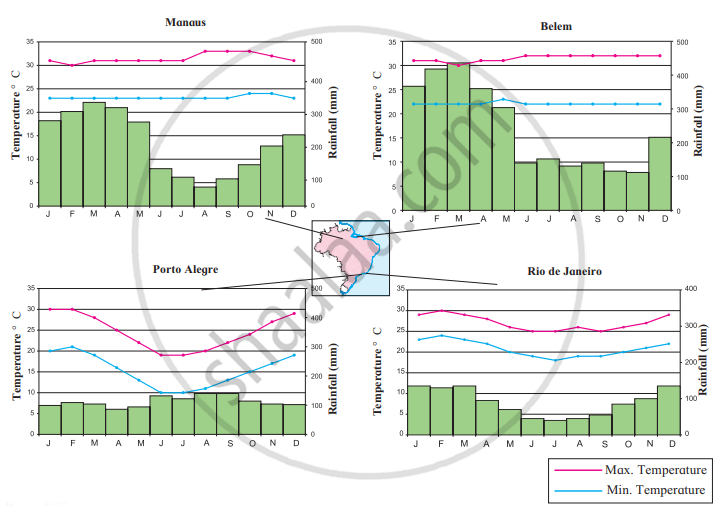
- In which month is the highest temperature found in all four cities?
- In which month does it rain the most in the given cities?
- When does Brazil have its rainy season?
- Which city has the maximum range of temperature? How much is it?
- What type of climate will be found in Rio De Janerio?
Considering the location, the extent of Brazil and India, look for the differences in the elements of climate like temperature and rainfall as per direction. Write a short note on it.
Write answer in one sentence-
Which type of climate is found in the south of tropic of Capricorn in Brazil?
Write about the climate variations in Brazil.
Which region of Brazil receives rainfall throughout the year?
