Advertisements
Advertisements
प्रश्न
Discuss the continuity and differentiability of f(x) at x = 2
f(x) = [x] if x ∈ [0, 4). [where [*] is a greatest integer (floor) function]
Advertisements
उत्तर
Explanation:
x ∈ [0, 4)
∴ 0 ≤ x < 4
we will plot graph for 0 ≤ x < 4
Not for x < 0 and upto x = 4 making on X-axis.
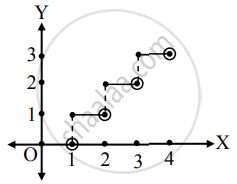
f(x) = [x]
∵ Greatest integer function is discontinuous at all integer values of x and hence not differentiable at all integers.
∴ f is not continuous at x = 2.
∵ f(x) `{:(= 1, x < 2),(= 2, x ≥ 2):}}` x ∈ neighbourhood of x = 2.
∴ L.h.lim = 1, R.h.lim = 2
∴ f is not a continuous function.
∴ f is not differentiable function.
APPEARS IN
संबंधित प्रश्न
Find the derivative of the following function w. r. t. x.:
`7xsqrt x`
Find the derivative of the following function w. r. t. x.:
35
Differentiate the following w. r. t. x. : `x sqrtx + logx − e^x`
Differentiate the following w. r. t. x. : `x^(5/2) + 5x^(7/5)`
Differentiate the following w. r. t. x. : `2/7 x^(7/2) + 5/2 x^(2/5)`
Differentiate the following w. r. t. x. : `sqrtx (x^2 + 1)^2`
Differentiate the following w. r. t. x. : x3 log x
Differentiate the following w. r. t. x. : `x^(5/2) e^x`
Differentiate the following w. r. t. x. : ex log x
Find the derivative of the following w. r. t. x by using method of first principle:
x2 + 3x – 1
Find the derivative of the following w. r. t. x by using method of first principle:
e2x+1
Find the derivative of the following w. r. t. x by using method of first principle:
3x
Find the derivative of the following w. r. t. x by using method of first principle:
tan (2x + 3)
Find the derivative of the following w. r. t. x. at the point indicated against them by using method of first principle:
`sqrt(2x + 5)` at x = 2
Find the derivative of the following w. r. t. x. at the point indicated against them by using method of first principle:
`2^(3x + 1)` at x = 2
Find the derivative of the following w. r. t. x. at the point indicated against them by using method of first principle:
`"e"^(3x - 4)` at x = 2
Find the derivative of the following w. r. t. x. at the point indicated against them by using method of first principle:
cos x at x = `(5pi)/4`
Show that the function f is not differentiable at x = −3, where f(x) `{:(= x^2 + 2, "for" x < - 3),(= 2 - 3x, "for" x ≥ - 3):}`
Show that f(x) = x2 is continuous and differentiable at x = 0
Discuss the continuity and differentiability of f(x) = (2x + 3) |2x + 3| at x = `- 3/2`
If f(x) `{:(= sin x - cos x, "if" x ≤ pi/2),(= 2x - pi + 1, "if" x > pi /2):}` Test the continuity and differentiability of f at x = `π/2`
Select the correct answer from the given alternative:
If f(x) `{:( = x^2 + sin x + 1, "for" x ≤ 0),(= x^2 - 2x + 1, "for" x ≤ 0):}` then
Select the correct answer from the given alternative:
If, f(x) = `x^50/50 + x^49/49 + x^48/48 + .... +x^2/2 + x + 1`, thef f'(1) =
Determine whether the following function is differentiable at x = 3 where,
f(x) `{:(= x^2 + 2"," , "for" x ≥ 3),(= 6x - 7"," , "for" x < 3):}`
Determine the values of p and q that make the function f(x) differentiable on R where
f(x) `{:( = "p"x^3",", "for" x < 2),(= x^2 + "q"",", "for" x ≥ 2):}`
Discuss whether the function f(x) = |x + 1| + |x – 1| is differentiable ∀ x ∈ R
Test whether the function f(x) `{:(= 2x - 3",", "for" x ≥ 2),(= x - 1",", "for" x < 2):}` is differentiable at x = 2
Test whether the function f(x) `{:(= x^2 + 1",", "for" x ≥ 2),(= 2x + 1",", "for" x < 2):}` is differentiable at x = 2
Test whether the function f(x) `{:(= 5x - 3x^2",", "for" x ≥ 1),(= 3 - x",", "for" x < 1):}` is differentiable at x = 1
If y = `"e"^x/sqrt(x)` find `("d"y)/("d"x)` when x = 1
