Advertisements
Advertisements
प्रश्न
Discuss any two properties of the indifference curve.
State any two properties of indifference curves.
Give any two properties of indifference curves.
Justify the properties of the indifference curve.
What are the properties of an indifference curve? Explain with the help of diagrams.
Advertisements
उत्तर
- An indifference curve (IC) always slopes downward: This property implies that to increase the consumption of X-good, the consumer has to reduce the consumption of Y-good so as to remain at the same level of satisfaction.

As shown in the given diagram:
To increase the quantity of ‘X’ good from OX to OX1, the consumer has to reduce good Y from OY to OY1.
-
Indifference curves are convex to the origin: This property is based on the principle of diminishing marginal rate of substitution. It implies that as the consumer substitutes X for Y, the marginal rate of substitution between them goes on diminishing, as shown in the following figure.
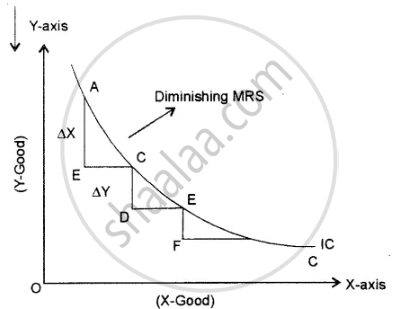
AB > CD > EF or diminishing MRS. - Indifference Curve will not touch either the X-axis or the Y-axis. An indifference curve cannot touch the X-axis or Y-axis because the customer would consume only one good. Indifference curves show equal-satisfaction pairings of items. No combination or trade-off exists if one good is zero; hence, the marginal rate of substitution doesn't apply. Therefore, the curve cannot contact either axis.
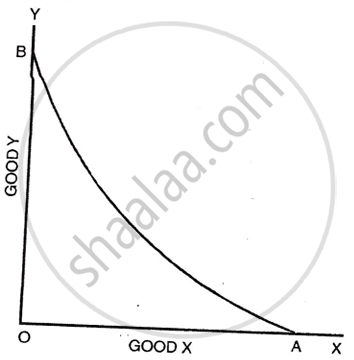
- Indifference Curves Neither Touch nor Intersect Each Other: Different indifference curves indicate satisfaction. If two curves contact or cross, the identical commodities combination will produce two separate pleasure ratings, which is impossible. The assumption of consistent consumer choices is broken. Indifference curves cannot touch or cross.
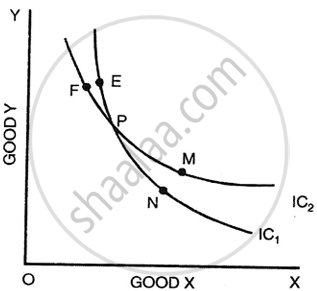
Two curves intersecting (at point P) would mean the same combination of goods gives two satisfaction levels, which is impossible. This violates the assumption of consistent consumer preferences, so indifference curves can’t cross. - A higher indifference curve represents a higher level of satisfaction: when more of one good is accessible, a steeper indifference curve is farther from the origin. Since more commodities generate more utility (assuming both are desirable), a higher indifference curve point indicates greater satisfaction.
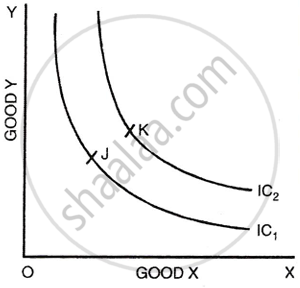
Curve IC2 lies above IC1, meaning it represents a higher level of satisfaction due to more of at least one good. - Indifference Curves Need Not Be Parallel to Each Other: Indifference curves need not be parallel since commodities' Marginal Rate of Substitution (MRS) may vary with consumption. Curve design and spacing depend on consumer preferences. While they are all downward sloping and convex, their steepness or curvature may vary, making them not parallel.
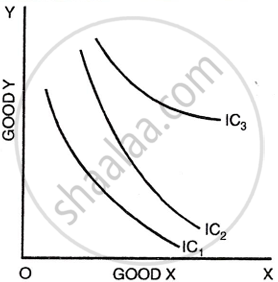
IC1, IC2, and IC3 are not equally spaced or shaped, showing that curves may vary with preferences and MRS.
They all slope downward and are convex, but they need not be parallel to one another. - Indifference Curves for Perfect Substitutes and Perfect Complements: Indifference Curves for Perfect Substitutes are straight lines because the consumer is willing to substitute one good for another at a constant rate. For example, if 1 pen = 1 pencil, the consumer doesn’t prefer one over the other. Indifference curves for perfect complements are L-shaped because the goods are used together in fixed proportions. More of one good without the other doesn't increase satisfaction. Example: Left and right shoes.
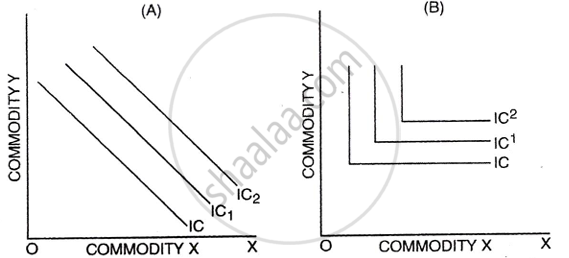
(A) shows straight-line indifference curves for perfect substitutes where goods are exchanged at a constant rate.
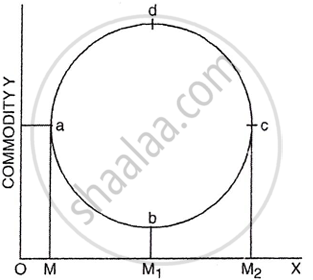
(B) shows L-shaped curves for perfect complements, consumed in fixed proportions (like left and right shoes). - Indifference Curve may be Circular: an indifference curve is never circular because it violates the basic property of diminishing marginal rate of substitution (MRS). A circular curve would imply that the MRS is the same in all directions, which is not realistic for most consumer preferences.
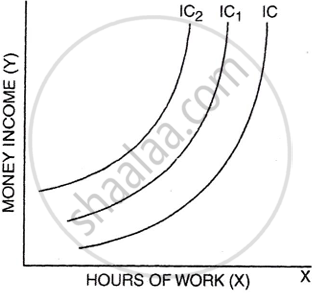
- Indifference Curves of Inferior Goods: Indifference curves for inferior goods are downward sloping and convex, just like normal goods. The shape doesn’t change. What makes a good "inferior" is that as income increases, the consumer buys less of it, not the shape of the curve.
Notes
Students should refer to the answer according to their question and preferred marks.
