Advertisements
Advertisements
प्रश्न
Differentiate between near vision and distant vision (Shape of the eye lens).
Differentiate between the following pair on the basis of what is mentioned within brackets.
Near vision and Distant vision (Shape of the eye lens)
Advertisements
उत्तर
| Near vision | Distant vision |
| In near vision, the shape of the eye lens is convex. | In distant vision, the shape of the eye lens is thin and less convex. |
संबंधित प्रश्न
- Draw a well-labelled diagram of the membranous labyrinth found in the inner ear.
- Based on the diagram drawn above in (i), give a suitable term for each of the following descriptions:
- The sensory cells that help in hearing.
- The part that is responsible for static balance of the body.
- The membrane-covered opening that connects the middle ear to the inner ear.
- The fluid present in the middle chamber of cochlea.
- The structure that maintains dynamic equilibrium of the body.
Note the relationship between the first two words and suggest the suitable word for the fourth place.
sound : ear drum :: Dynamic balance : ……
Given below is a set of five parts. Rewrite them in correct sequence.
Cochlea, tympanum, auditory canal, ear ossicles, oval window.
Given below is the diagram of a part of the human ear. Study the same and answer the questions that follow:
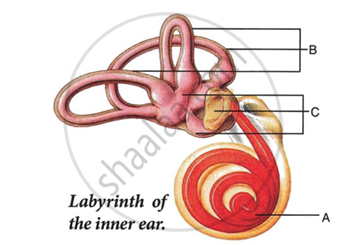 |
Give the collective biological term for Malleus, locus and Stapes.
Draw a neat and labelled diagram of the human ear. With the help of this diagram, explain the construction and working of the human ear.
Choose the correct answer.
Canal joining middle ear to pharynx ___________
The figure below is the sectional view of a part of the skull showing a sense organ:
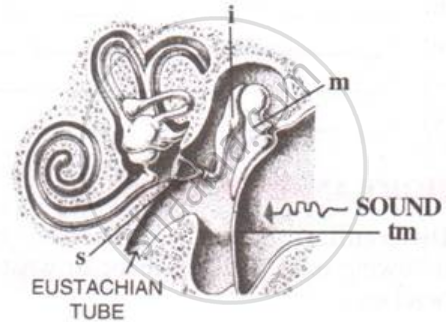
What do you call the part shown in the form of a spiral? What is its function?
Categorise the following parts under (i) external, (ii) middle and (iii) internal ear.
Ear drum, hammer, pinna, cochlea, anvil, stirrup, eustachian tube, tympanum, oval window, semi-circular canals.
With reference to human ear answer the question that follow:
Name the part of the ear associated with dynamic balance.
Name the part of the inner ear that is responsible for static balance in human beings.
