Advertisements
Advertisements
प्रश्न
Diagram alongside shows a smooth, but stiff cardboard ABCD, held horizontally, such that a straight thick copper conductor passes through the middle of cardboard. On the cardboard are sprinkled fine iron filings. A current is made to flow through the conductor as shown in diagram.
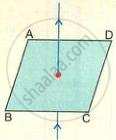
- Copy the diagram and describe what happens to the iron filings? Give an explanation.
- If instead of iron filings, a plotting magnetic compass is used, draw the magnetic line of force produced in diagram and show its direction.
- Name and state two rules by which you can find the direction of magnetic field around the straight conductor carrying current.
Advertisements
उत्तर
(a)
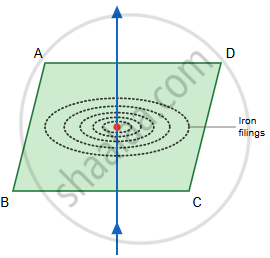
When the current is switched on and the cardboard is gently tapped, the iron filings arrange themselves in concentric circles around the conductor, with the conductor at the center.
Explanation: A current-carrying conductor produces a magnetic field around it. The magnetic lines of force of a straight conductor are concentric circles lying in a plane perpendicular to the conductor. The iron filings get magnetised by induction and align themselves along these lines of force. The circles are closer near the conductor, showing that the field is stronger near the conductor and becomes weaker as the distance increases.
(b) When a plotting compass is placed at different points around the conductor and the positions of its north pole are marked, the magnetic lines of force are found to be concentric circles around the conductor. Since the current flows upward (from bottom to top through the cardboard), the lines of force are in the anticlockwise direction when viewed from above. The north pole of the compass needle always points along the tangent to the circle in the anticlockwise direction.
(c) The two rules are:
- Right-hand thumb rule: If the current-carrying conductor is held in the right hand such that the thumb points in the direction of current, then the direction in which the fingers curl around the conductor gives the direction of the magnetic lines of force.
- Maxwell’s corkscrew rule (right-handed screw rule): If a right-handed corkscrew is imagined to be driven along the conductor in the direction of current, then the direction in which the handle of the screw is turned gives the direction of the magnetic lines of force.
