Advertisements
Advertisements
प्रश्न
Describe T.S. of the spinal cord.
Advertisements
उत्तर
T.S. of the spinal cord shows the following features:
- The spinal cord is externally covered by the three meninges (dura mater, arachnoid mater, and pia mater). It is cylindrical but dorsoventrally flattened.
- It shows deep ventral fissure and shallow dorsal fissure. From the dorsal fissure, there extends a thin sheet of connective tissue called the dorsal septum which extends inward.
- It shows a central space called the central canal. The central canal is continuous with the 4th ventricle of the brain and contains cerebrospinal fluid. The central canal is lined by a single layer of ependymal cells. The central canal is surrounded by inner, grey matter containing cytons or cell bodies of neurons.
- Two dorsolateral horns and two ventrolateral horns give an ‘H’-shaped appearance to the grey matter. Dorsal horns extend in dorsal roots, while ventral horns extend in ventral roots of spinal nerves. Grey matter is surrounded by the white matter which divides into three columns or funiculi on either side. These are dorsal funiculi, lateral funiculi and ventral funiculi.

APPEARS IN
संबंधित प्रश्न
Name the following:
Inability to speak.
Where is this located?
Ganglia
Give Technical Term:
The brain and spinal cord together constitute the system known as.
The diagram given below shows the internal structure of the spinal cord, depicting a simple reflex. Study the same and then answer the questions that follow:
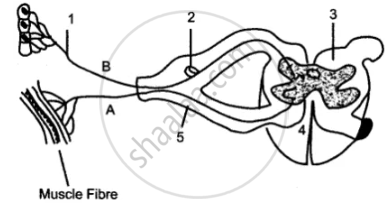
(i) Name the parts numbered 1 to 5.
(ii) Using the letters of the alphabet shown in the figure indicate the direction in which an impulse enters and leaves the spinal cord.
(iii) What is the term given to the point of contact between two nerve cells?
(iv) What is meant by ‘simple reflex’ ? Give two examples of simple reflexes and name the stimuli too.
(v) How does the arrangement of nerve cells in the spinal cord differ from that in the brain?
The diagram given below represents the spinal cord of a mammal, seen in a transverse section together with the nerves. Study the diagram and then answer the questions given below:
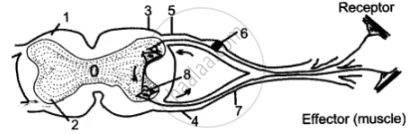
(i) Label the parts 1—8 indicated by guidelines.
(ii) What do the arrows indicate? What is the pathway indicated termed?
(iii) What type of nerve is shown in the diagram?
Identify the odd item from the following series of words.
Sketch and label T. S. of Spinal cord.
There are ______ pairs of cranial nerves and ______ pairs of spinal nerves.
Describe the structure of the spinal cord.
Sensory nerve fibres forming ascending tracts in white matter of spinal cord are located in ____________.
