Advertisements
Advertisements
प्रश्न
Describe the principle of simple periscope through an outline ray diagram. Give one of its uses.
Advertisements
उत्तर
Simple periscope is based upon the principle of reflection. It consists of cardboard or wooden tube, bent twice at right angles, and is provided with two openings as shown in the figure. Two plane mirrors are fixed at the bends of the tube at an angle 45° to the framework, such that the mirrors face each other. The tube is completely blackened from inside to avoid any reflection from its sides.

The parallel rays coming from an object at a higher plane, strike the plane mirror at an angle of 45° and hence are reflected through an angle of 45°.
These reflected rays strike the second mirror at an angle of 45° and hence are further reflected through an angle of 45°. These reflected rays on reaching the eye from the image on retina.
Use of periscope: It is used by soldiers in trench warfare.
APPEARS IN
संबंधित प्रश्न
Write true or false of the following statement.
The image of the right hand in a plane mirror looks like that of a left hand.
If the angle between the plane mirror and the incident ray is 40∘, what are the angles of incidence and reflection?
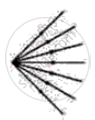
Identify the following kind of beam of light.

Identify the following kind of beam of light.
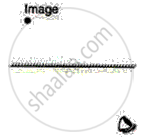
Complete the ray diagram to show the image observed by the eye after reflection in the following figure.
State the direction of incident ray which after reflection from a spherical mirror retraces its path. Give reason for your answer.
You can see a rainbow only when your back is towards the sun.
We can see objects because of ______.
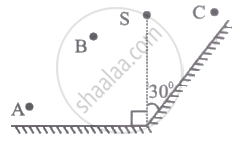
A point source of light S is placed in front of two large mirrors as shown. Which of the following observers will see only one image of S?