Advertisements
Advertisements
प्रश्न
Derive an expression for the energy of satellite.
Advertisements
उत्तर
The total energy of the satellite is the sum of its kinetic energy and gravitational potential energy. The potential energy of the satellite is,
U = `-("GM"_"s""M"_"E")/(("R"_"E" + "h"))` ......(1)
Here Ms – mass of the satellite, ME – mass of the Earth, RE – radius of the Earth.
The Kinetic energy of the satellite is
K.E = `1/2"M"_"s""v"^2` .............(2)
Here v is the orbital speed of the satellite and is equal to
v = `sqrt("GM"_"E"/(("R"_"E" + "h")))`
Substituting the value of v in (2) the kinetic energy of the satellite becomes,
K.E = `1/2("GM"_"E""M"_"s")/(("R"_"E" + "h"))`
Therefore the total energy of the satellite is
E = `1/2("GM"_"E""M"_"s")/(("R"_"E" + "h")) - ("GM"_"s""M"_"E")/(("R"_"E" + "h"))`
E = `-("GM"_"s""M"_"E")/(2("R"_"E" + "h"))`
The negative sign in the total energy implies that the satellite is bound to the Earth and it cannot escape from the Earth.
As h approaches ∞, the total energy tends to zero. Its physical meaning is that the satellite is completely free from the influence of Earth’s gravity and is not bound to Earth at a large distance.
APPEARS IN
संबंधित प्रश्न
The time period of a satellite orbiting Earth in a circular orbit is independent of
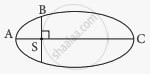
The kinetic energies of a planet in an elliptical orbit about the Sun, at positions A, B and C are KA, KB and KC respectively. AC is the major axis and SB is perpendicular to AC at the position of the Sun S as shown in the figure. Then
The kinetic energy of the satellite orbiting around the Earth is __________.
What is meant by escape speed in the case of the Earth?
What are geostationary and polar satellites?
Derive an expression for escape speed.
Derive the time period of the satellite orbiting the Earth.
Explain in detail the geostationary and polar satellites.
If the Earth has no tilt, what happens to the seasons of the Earth?
An unknown planet orbits the Sun with a distance twice the semi-major axis distance of the Earth’s orbit. If the Earth’s time period is T1, what is the time period of this unknown planet?
