Advertisements
Advertisements
प्रश्न
Define the following:
Excretory organs
Advertisements
उत्तर
During different metabolic activities taking place in our body, the body produces many substances of which some are useful and some are useless.
If retained in the body the unwanted substances may become poisonous and cause much harm and in severe cases, even death. The organs which remove these unwanted and toxic substances from the body are called excretory organs.
APPEARS IN
संबंधित प्रश्न
Sketch and label 'structure of nephron'.
Match the terms in Column I with those in Column II and write down the matching pairs
| Column I | Column II | |
| a | Bowman's Capsule | Renal artery |
| b | Contains more CO2 and less urea | Regulates amount of water excreted |
| c | Anti-diuretic hormone | Renal Vein |
| d | Contains more urea | Glomerulus |
The diagram given below represents an organ system in the human body. Study the same and answer the questions that follow :
Name the structural and functional units of the part marked 1.
Choose the correct answer:
Excess proteins are converted into urea in ____________
Look at the figure given below. It is a section of human kidney as seen from the front.
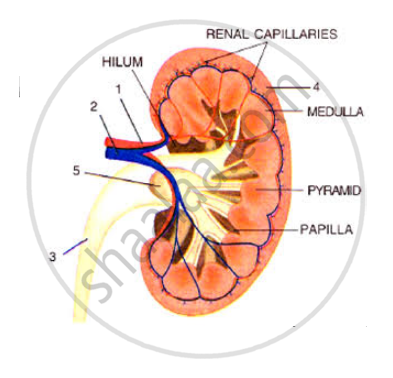
Name the parts numbered 1-5.
Differentiate between:
Excretion and Secretion.
The human kidneys are located on either side of the vertebral column at the level of ______.
Which one of the following statements is INCORRECT?
The maximum amount of electrolytes and water (70-80%) from the glomerular filtrate is reabsorbed in which part of the nephron.
The process of tubular secretion occurs in ______.
