Advertisements
Advertisements
प्रश्न
Consider one mole of perfect gas in a cylinder of unit cross section with a piston attached (figure). A spring (spring constant k) is attached (unstretched length L) to the piston and to the bottom of the cylinder. Initially the spring is unstretched and the gas is in equilibrium. A certain amount of heat Q is supplied to the gas causing an increase of volume from V0 to V1.
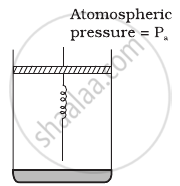
- What is the initial pressure of the system?
- What is the final pressure of the system?
- Using the first law of thermodynamics, write down a relation between Q, Pa, V, Vo and k.
Advertisements
उत्तर
a. Initially the piston is in equilibrium hence, Pf = Pa

b. On supplying heat, the gas expands from V0 to V1
∴ Increase in volume of the gas = V1 – V0
As the piston is of the unit cross-sectional area hence, extension in the spring

`x = (V_1 - V_0)/"Area" = V_1 - V_0`
∴ Force exerted by the spring on the piston
= `F = kx = k(V_1 - V_0)`
Hence, Final pressure = `P_f = P_a + kx`
= `P_a + k xx (V_1 - V_0)`
c. From the first law of thermodynamics `dQ = du + dW`
If T is the final temperature of the gas. then increases in internal energy
`dU = C_v (T - T_0) = C_v (T - T_0)`
We can write, `T = (P_f V_1)/R - [(P_a + k(V_1 - V_0))/R] V_1/R`
Work done by the gas = PdV + increase in PE of the spring
= `P_a (V_1 - V_0) + 1/2 kx^2`
Now, we can write `dQ = dU + dW`
= `C_V (T - T_0) + P_a (V - V_0) + 1/2 kx^2`
= `C_V (T - T_0) + P_a (V_ V_0) + 1/2 (V_1 - V_0)^2`
This is the required relation.
