Advertisements
Advertisements
प्रश्न
Consider a water tank shown in the figure. It has one wall at x = L and can be taken to be very wide in the z direction. When filled with a liquid of surface tension S and density ρ, the liquid surface makes angle θ(θ << 1) with the x-axis at x = L. If y(x) is the height of the surface then the equation for y(x) is:
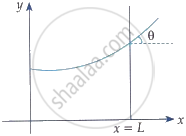
(take θ(x) = sin θ(x) = tan θ(x) = `dy/dx`, g is the acceleration due to gravity)
पर्याय
`(d^2y)/(dx^2) = (rho g)/S x`
`(d^2 y)/(dx^2) = (rho g)/S y`
`(d^2 y)/(dx^2) = sqrt((rho g)/S)`
`dy/dx = sqrt((rho g)/S) x`
Advertisements
उत्तर
`bb((d^2 y)/(dx^2) = (rho g)/S y)`
Explanation:
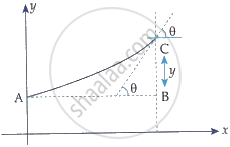
From Pascal’s law, PA = PB = Po (atmospheric pressure)
PB = Po = PC − yρg
⇒ PC = Po − yρg
`P_o - S/r`
S = surface tension
r = radius of the meniscus at C
∴ yρg = `S/r` ...(i)
r = `([1 + (dy/dx)^2]^(3/2))/((d^y)/(d x^2))`
Slope = `dy/dx` = tan θ
Since θ is very small, `dy/dx` is also very small and hence rejected.
Hence, r = `1/((d^2 y)/(d x^2))` ...(ii)
Putting r in Eq. (i), we get
yρg = `S (d^2 y)/(d x^2)`
`(d^2 y)/(d x^2) = (rho g)/S y`
