Advertisements
Advertisements
प्रश्न
Complete the following food chain by writing the names of appropriate organisms in the blanks:
→ __________ → __________ → Hen → Man
Advertisements
उत्तर
→ Grass → Insects → Hen → Man
संबंधित प्रश्न
the exact location of the Thylakoids
The diagram below shows two test-tubes A and B. Test-tube A contains a green water plant. Test-tube B contains both a green water plant and a snail. Both testtubes are kept in sunlight. Answer the questions that follow:

(i) Name the physiological process that releases the bubbles of oxygen.
(ii) Explain the physiological process as mentioned above in Q2 (a)(i).
(iii) What is the purpose of keeping a snail in test-tube ‘B’?
(iv) Why does test-tube ‘B’ have more bubbles of oxygen?
(v) Given an example of a water plant that can be used in the above process.
(vi) Write the overall chemical equation for the above process.
Distinguish between the following:
Photosynthesis and photophosphorylation.
Mention two ways in which photosynthesis is useful to life.
Identify the false statement and rewrite it correctly by changing the first or last word only.
Green plants are consumers.
What is meant by the photolysis of water?
Photosynthesis is considered as a process supporting all life on earth.
The role of chlorophyll is to absorb light from the sun.
Give an example for micronutrients.
Study the diagram given below and fill in the blanks with suitable words:
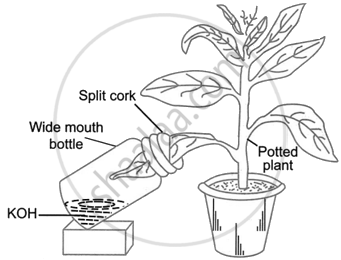
In order to prove that carbon dioxide is necessary for
(a) ______, a potted plant is placed in dark for 48 hours to (b) ______ the leaves. A part of a leaf is inserted into a conical flask containing potassium hydroxide solution. This is to absorb (c) ______ from the flask. The plant is then placed in sunlight for a few hours. The experimental leaf is tested for starch. The part of the leaf that was inside the conical flask turns (d) ______, whereas the part of the left outside turns (e) ______ in colour.
