Advertisements
Advertisements
प्रश्न
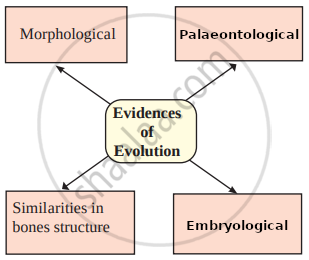
Complete the following chart:

Advertisements
उत्तर

APPEARS IN
संबंधित प्रश्न
What are vestigial organs?
Give two examples of vestigial organs in human beings and plants.
Given below is the list of vegetables available in the market. Select from these the two vegetables having homologous structures:
Potato, sweet potato, ginger, radish, tomato, carrot, okra (Lady’s finger)
(A) Potato and sweet potato
(B) Radish and carrot
(C) Okra and sweet potato
(D) Potato and tomato
State a reason for the increased population of dark coloured moths coinciding with the loss of lichens (on tree barks) during industrialization period in England.
Which of the following is a correct set of homologous organs?
(a) Forelimbs of frog, bird and lizard
(b) Spine of cactus and thorn of bougainvillea
(c) Wings of bat and wings of butterfly
(d) Wings of a bird and wings of a bat
Which one of the following pairs of vegetables is an example of homologous structures?
(A) Potato and sweet potato
(B) Carrot and radish
(C) Carrot and tomato
(D) Tomato and radish
Can the wing of a butterfly and the wing of a bat be considered homologous organs? Why or why not?
An example of homologous organs is
Attempt giving a clear definition of the term species.
Explain the evolution of giraffe's neck according to Lamarck's theory of evolution.
Differentiate between analogous and homologous structures.
Out of bacteria, spider, fish and chimpanzee, which organism has a better body design in evolutionary terms? Give reason for your answer.
Some dinosaurs had feathers although they could not fly birds have feathers that help them to fly. In the context of evolution, this means that ______
The presence of which of the following types of organs in two animals indicates that they are not derived from a common ancestor?
(a) homologous organs
(b) excretory organs
(c) analogous organs
(d) reproductive organs
One pair of organs in the following animals are not homologous. This is :
(a) forelimbs in humans and lizard
(b) forelimbs in lizard and frog
(c) wings in butterfly and bat
(d) wings in bat and bird
The organs P and Q of two animals have different structures but similar functions. On the other hand, the two organs R and S of two other animals have the same basic structure but different functions.
(a) What are the organs like P and Q known as?
(b) Name the organs like P and Q. Also name the animals which have such organs.
(c) What are the organs like R and S called?
(d) Name the organs like R and S. Also name the animals which have such organs.
Write short notes based upon the information known to you.
Connecting link
“Appearance of melanised moths post-industrialisation in England is a classic example of evolution by natural selection.” Explain.
Differentiate between connecting links and the missing links.
What are homologous structures?
Very short answer question:
What is vestigeal organ?
______ is a vestigial organ in human beings.
Name the parts shown in the diagram.
Human jaw

The decaying process of C-14 occurs continuously in dead organisms only.
Which evidence of evolution is shown in the given picture? Explain the importance of this evidence.

How do you differentiate homologous organs from analogous organs?
Define vestigial organs.
Why do all the gametes formed in human females have an X chromosome?
Animal husbandry and plant breeding programmes are the examples of ______.
Fossils are generally found in ______.
How do we compute the age of a living tree?
How do we compute the age of a rock?
The evolutionary story of moths in England during industrialisation reveals, that 'evolution is apparently reversible'. Clarify this statement.
You have studied the story of Peppermoths in England. Had the industries been removed, what impact could it have had on the moth population? Discuss.
Complete the following diagram:

Explain natural selection with the example of industrial melanism.
Define the term:
Homologous organs
Complete the following conceptual picture:

Define Palaeontology.