Advertisements
Advertisements
प्रश्न
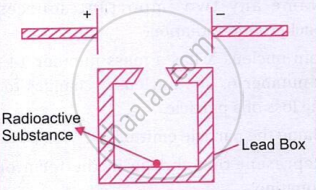
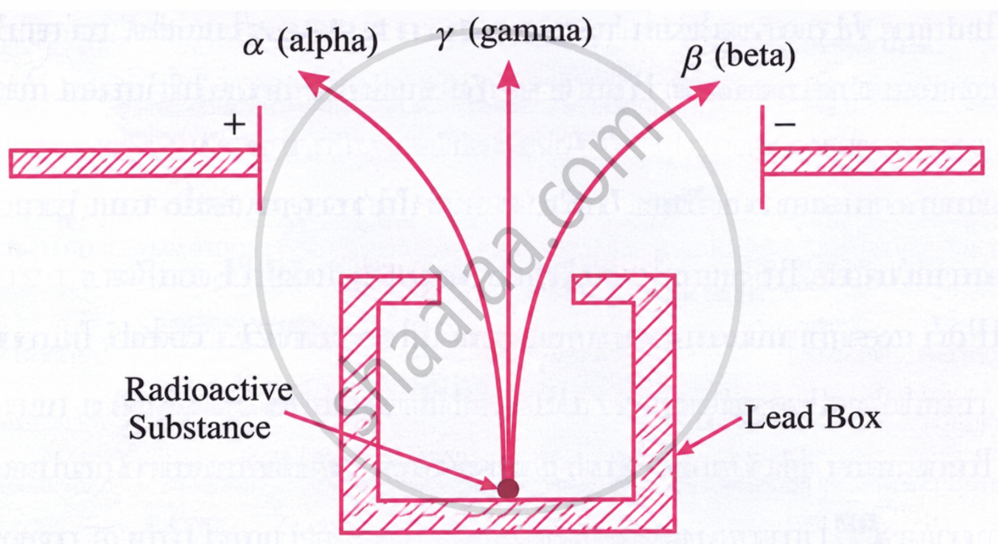
Complete the diagram as given above by drawing the deflection of radioactive radiations in an electric field.
Advertisements
उत्तर
संबंधित प्रश्न
What is thermionic emission?
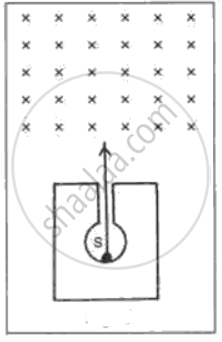
In following fig. shows a mixed source S of alpha and beta particles in a thick lead container. The particles pass through a magnetic field in a direction perpendicular to the plane of paper (inwards as shown by x). State and show in the diagram how the particles get affected.
A nucleus $${}_{84}\mathrm{X}^{202}$$ of an element emits an alpha particle followed by a beta particle. The final nucleus is $${}_{\mathrm{a}}\mathrm{Y}^{\mathrm{b}}$$. Find a and b.
What is nucleus of an atom? Compare its size with that of the atom. Name its constitutents. How is the number of these constituents determined by the atomic number its atomic model.
What do you mean by electron emission?
What do you understand by the term radioactivity?
Complete the following radioactive reaction:
\[ {}^{\cdots\cdots}_{\cdots\cdots}\mathrm{X} \longrightarrow \mathrm{Y} + {}^{4}_{2}\mathrm{He} \longrightarrow {}^{234}_{\;91}\mathrm{Z} + {}^{\;\;0}_{-1}\mathrm{e}\]
When an α-particle of mass m moving with velocity ν bombards on a heavy nucleus of charge Ze, its distance of closest approach from the nucleus depends on m as:
Assertion (A): The force of repulsion between atomic nucleus and α-particle varies with distance according to inverse square law.
Reason (R): Rutherford did α-particles scattering experiment.
In the discovery of radioactivity, why could the darkening of the covered photographic plate NOT be explained by ordinary visible light?
