Advertisements
Advertisements
प्रश्न
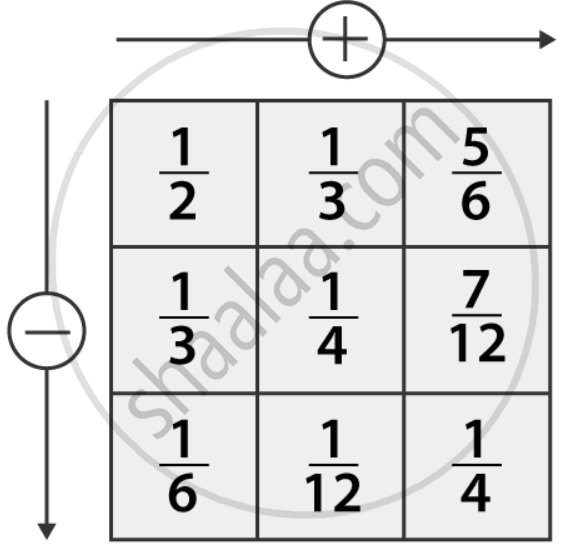
Complete the addition-subtraction box.

Advertisements
उत्तर
`1/2 + 1/3`
= `[(1 xx 3) + (1 xx 2)]/6`
= `(3 + 2)/6`
= `5/6`
`1/3 + 1/4`
= `[(1 × 4) + (1 xx 3)]/12`
= `(4 + 3)/12`
= `7/12`
`1/2 - 1/3`
= `[(1 xx 3) – (1 xx 2)]/6`
= `(3 - 2)/6`
= `1/6`
`1/3 - 1/4`
= `[(1 xx 4) – (1 xx 3)]/12`
= `(4 - 3)/12`
= `1/12`
`1/6 + 1/12`
= `[(1 xx 2) + 1]/12`
= `(2 + 1)/12`
= `3/12`
= `1/4`
Hence, the complete given box is
संबंधित प्रश्न
Add:
`2/7 + 1/7 + 3/7`
Subtract:
`3/4 - 1/2`
Add:
`2/21 + 3/7`
Add the following fractions
`2/9 + 1/9`
Sum of `4/17` and `15/17` is ______.
What is wrong in the following additions?
`6 1/2`
+ `2 1/4`
= `8 2/6 = 8 1/3`
Shubham painted `2/3` of the wall space in his room. His sister Madhavi helped and painted `1/3` of the wall space. How much did they paint together?
Solve:
`3/10 + 7/15`
Solve:
`4/9 + 2/7`
For adding mixed fractions (e.g., 5 `1/2` + 2 `3/4`), how are the whole numbers handled?
