Advertisements
Advertisements
प्रश्न
Compare the energy changes involved during a physical and a chemical change.
Advertisements
उत्तर
- Physical change: No gain or loss of energy during physical change.
The energy required for completion of a physical change is released when the change is reversed. - Chemical change: Energy is either absorbed or evolved during the chemical change.
The energy in the form of light, percussion (pressure), or generally heat energy is required for a chemical change.
APPEARS IN
संबंधित प्रश्न
Photosynthesis cannot take place at night.
Solve this crossword by using the clues that follow.

Across
1. Energy in the form of sunlight is absorbed by the green plants in this process.
4. The reddish-brown substance formed over iron in the presence of oxygen and moisture.
5. This change is permanent and irreversible.
6. The process in which a solid directly changes into gaseous state.
Down
1. It is the change that takes place in case of swinging pendulum of a clock.
2. Occurrence of this is a non-periodic change as well as a natural change.
3. It is a physical change
State whether the following is physical or chemical changes.
respiration in living beings —
State whether the following is physical or chemical changes.
photosynthesis —
Match the columns.
| Column A | Column B |
| 1. a change which cannot be easily reversed | a. man-made change |
| 2 a change that repeats itself at regular intervals | b. chemical chang |
| 3. a change that is made by humans | c. physical change |
| 4. a change in which the original substance cannot be obtained | d. periodic change |
| 5. a change where no new substance is formed | e. irreversible change |
| f . slow change |
Write true or false
Burning of paper and formation of curd are reversible changes.
Solve this crossword by using the clues that follow-
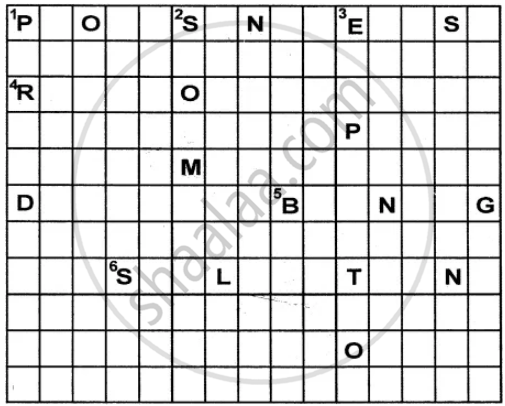
Across
1. Energy in the form of sunlight is absorbed by the green plants in this process.
4. The reddish-brown substance formed over iron in the presence of oxygen and moisture.
5. This change is permanent and irreversible.
6. The process in which a solid directly changes into gaseous state.
Down
1 . It is the change that takes place in case of swinging pendulum of a clock. –
2. Occurrence of this is a non-periodic change as well as a natural change.
3. It is a physical change.
Separate the following into physical and chemical changes :
Sublimation of a solid, Decomposition of water into hydrogen and oxygen by passing electric current, Formation of clouds, Making a fruit salad from raw fruits, Dissolving carbon dioxide in water
Select the correct answer from the choice given below to complete the sentence
The dissolution of lead nitrate in water is deemed as a _________ change.
Give the reason why the following is considered as chemical changes.
A bright light is seen evolved when a strip of magnesium is heated.
