Advertisements
Advertisements
प्रश्न
Compare and contrast revenue curves under different market conditions.
सविस्तर उत्तर
Advertisements
उत्तर
- Perfect Competition
- Features:
- Many buyers and sellers.
- Identical (homogeneous) products.
- Firms are price takers (cannot set their own price).
- Revenue Curves:
- AR = MR = Price (all are constant).
- AR and MR are horizontal straight lines.
- TR increases at a constant rate with output.
- Example: If the price is ₹10, then:
- TR = ₹10 × Quantity
- AR = ₹10
- MR = ₹10
- Diagram:

- Features:
- Monopoly
- Features:
-
-
- Single seller.
- No close substitutes.
- Firm is a price maker.
-
-
- Revenue Curves:
-
-
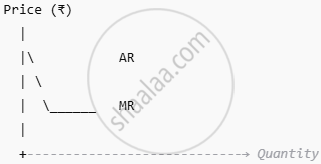
- AR is downward sloping.
- MR also slopes downward but lies below AR.
- TR rises at first, reaches a maximum, and then falls.
-
-
- Explanation: To sell more, the monopolist must reduce the price, not only for the extra unit but also for all previous units; that’s why MR falls faster.
- Diagram:
- Monopolistic Competition
- Features:
- Many sellers.
- Slightly different products.
- Firms have some control over price.
- Revenue Curves:
- AR slopes downward (like monopoly).
- MR lies below AR.
- Both curves are more elastic than monopoly (flatter), due to the availability of substitutes.
- Diagram:
(Similar to monopoly but flatter AR and MR)
- Features:
- Oligopoly
- Features:
-
-
- Few large firms.
- High interdependence among firms.
- Products may be the same or different.
-
-
- Revenue Curves:
-
-
- AR slopes downward.
- MR may have a gap or kink due to price rigidity (explained in the kinked demand model).
- Firms avoid changing prices because competitors may or may not follow.
-
Comparison Table:
| Market Type | AR Curve | MR Curve | TR Curve |
| Perfect Competition | Horizontal | Horizontal (same as AR) | Straight, rising line |
| Monopoly | Downward sloping | Below AR, downward | Rises, then falls |
| Monopolistic Competition | Downward sloping | Below AR, more elastic | Rises then slows down |
| Oligopoly | Kinked (possible) | Discontinuous (gap) | Rises, then flattens |
shaalaa.com
या प्रश्नात किंवा उत्तरात काही त्रुटी आहे का?
पाठ 7: Revenue Analysis - TEST QUESTIONS [पृष्ठ ७.१६]
