Advertisements
Advertisements
प्रश्न
| Column A | Column B |
| (a) If E1 and E2 are the two mutually exclusive events | (i) E1 ∩ E2 = E1 |
| (b) If E1 and E2 are the mutually exclusive and exhaustive events | (ii) (E1 – E2) ∪ (E1 ∩ E2) = E1 |
| (c) If E1 and E2 have common outcomes, then | (iii) E1 ∩ E2 = Φ, E1 ∪ E2 = S |
| (d) If E1 and E2 are two events such that E1 ⊂ E2 | (iv) E1 ∩ E2 = Φ |
जोड्या लावा/जोड्या जुळवा
Advertisements
उत्तर
| Column A | Column B |
| (a) If E1 and E2 are the two mutually exclusive events | (iv) E1 ∩ E2 = Φ |
| (b) If E1 and E2 are the mutually exclusive and exhaustive events | (iii) E1 ∩ E2 = Φ, E1 ∪ E2 = S |
| (c) If E1 and E2 have common outcomes, then | (ii) (E1 – E2) ∪ (E1 ∩ E2) = E1 |
| (d) If E1 and E2 are two events such that E1 ⊂ E2 | (i) E1 ∩ E2 = E1 |
Explanation:
(a) If E1 and E2 are mutually exclusive events, then E1 ∩ E2 = Φ.
(b) If E1 and E2 are mutually exclusive and exhaustive events then E1 ∩ E2 = Φ and E1 ∪ E2 = S.
(c) If E1 and E2 have common outcomes, then (E1 – E2) ∪ (E1 ∩ E2) = E1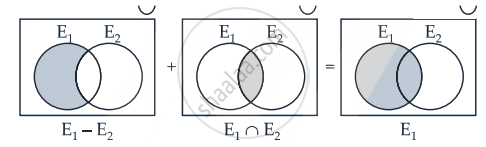
(d) If E1 and E2 are two events such that
E1 ⊂ E2 ⇒ E1 ∩ E2 = E1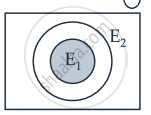
shaalaa.com
या प्रश्नात किंवा उत्तरात काही त्रुटी आहे का?
