Advertisements
Advertisements
प्रश्न
Choose the correct alternative :
The maximum value of z = 10x + 6y, subjected to the constraints 3x + y ≤ 12, 2x + 5y ≤ 34, x ≥ 0, y ≥ 0 is.
पर्याय
56
`65
55
66
Advertisements
उत्तर
Z = 10x + 6y
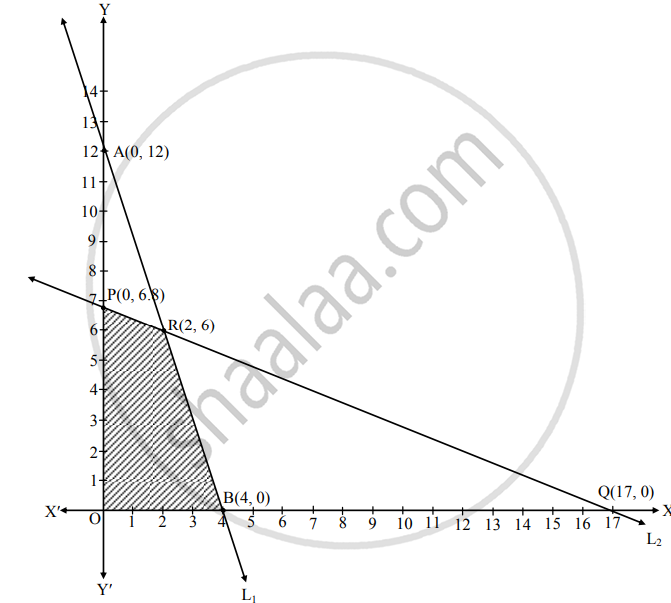
The given inequalities are 3x + y ≤ 12 and 2x + 5y ≤ 34.
Consider line L1 and L2 where
L1 : 3x + y = 12, L2 : 2x + 5y = 34
For line L1, plot A (0, 12) and B (4, 0)
For line L2, plot P (0, 6.8) and Q (17, 0)
Solving both lines, we get x = 2, y = 6.
The coordinates of origin O (0, 0) satisfies both the inequalities.
∴ The required region is on the origin side of both the lines L1 and L2.
As x ≥ 0, y ≥ 0, the feasible region is in the 1st quadrant.
OBRPO is the required feasible region.
At O (0, 0), Z = 0
At B (4, 0), Z = 10 (4) + 0 = 40
At R (2, 6), Z = 10 (2) + 6 (6) = 56
At P (0, 6.8), Z = 0 + 6 (6.8) = 40.8
The maximum value of Z is 56 and it occurs at R (2, 6).
APPEARS IN
संबंधित प्रश्न
A company produces two types of goods A and B, that require gold and silver. Each unit of type A requires 3 g of silver and 1 g of golds while that of type B requires 1 g of silver and 2 g of gold. The company can procure a maximum of 9 g of silver and 8 g of gold. If each unit of type A brings a profit of Rs 40 and that of type B Rs 50, formulate LPP to maximize profit.
The corner points of the feasible region determined by the following system of linear inequalities:
2x + y ≤ 10, x + 3y ≤ 15, x, y ≥ 0 are (0, 0), (5, 0), (3, 4) and (0, 5). Let Z = px + qy, where p, q > 0. Condition on p and q so that the maximum of Z occurs at both (3, 4) and (0, 5) is
Solve the following L.P.P. by graphical method:
Minimize: Z = 6x + 2y subject to x + 2y ≥ 3, x + 4y ≥ 4, 3x + y ≥ 3, x ≥ 0, y ≥ 0.
Fill in the blank :
Graphical solution set of the in equations x ≥ 0, y ≥ 0 is in _______ quadrant
The region represented by the inequality y ≤ 0 lies in _______ quadrants.
The constraint that a factory has to employ more women (y) than men (x) is given by _______
State whether the following is True or False :
The region represented by the inqualities x ≤ 0, y ≤ 0 lies in first quadrant.
Graphical solution set of x ≤ 0, y ≥ 0 in xy system lies in second quadrant.
Solve the following problem :
Minimize Z = 4x + 2y Subject to 3x + y ≥ 27, x + y ≥ 21, x ≥ 0, y ≥ 0
Solve the following problem:
Maximize Z = 4x1 + 3x2 Subject to 3x1 + x2 ≤ 15, 3x1 + 4x2 ≤ 24, x1 ≥ 0, x2 ≥ 0
Maximize Z = 60x + 50y Subject to x + 2y ≤ 40, 3x + 2y ≤ 60, x ≥ 0, y ≥ 0
A carpenter makes chairs and tables, profits are ₹ 140 per chair and ₹ 210 per table. Both products are processed on three machines, Assembling, Finishing and Polishing. The time required for each product in hours and the availability of each machine is given by the following table.
| Product/Machines | Chair (x) |
Table (y) |
Available time (hours) |
| Assembling | 3 | 3 | 36 |
| Finishing | 5 | 2 | 50 |
| Polishing | 2 | 6 | 60 |
Formulate and solve the following Linear programming problems using graphical method.
Solve the following problem :
A factory produced two types of chemicals A and B The following table gives the units of ingredients P & Q (per kg) of Chemicals A and B as well as minimum requirements of P and Q and also cost per kg. of chemicals A and B.
| Ingredients per kg. /Chemical Units | A (x) |
B (y) |
Minimum requirements in |
| P | 1 | 2 | 80 |
| Q | 3 | 1 | 75 |
| Cost (in ₹) | 4 | 6 |
Find the number of units of chemicals A and B should be produced so as to minimize the cost.
Choose the correct alternative:
If LPP has optimal solution at two point, then
Choose the correct alternative:
The minimum value of Z = 4x + 5y subjected to the constraints x + y ≥ 6, 5x + y ≥ 10, x, y ≥ 0 is
Choose the correct alternative:
The point at which the minimum value of Z = 8x + 12y subject to the constraints 2x + y ≥ 8, x + 2y ≥ 10, x ≥ 0, y ≥ 0 is obtained at the point
Choose the correct alternative:
The corner points of feasible region for the inequations, x + y ≤ 5, x + 2y ≤ 6, x ≥ 0, y ≥ 0 are
State whether the following statement is True or False:
If LPP has two optimal solutions, then the LPP has infinitely many solutions
State whether the following statement is True or False:
Corner point method is most suitable method for solving the LPP graphically
State whether the following statement is True or False:
Of all the points of feasible region, the optimal value is obtained at the boundary of the feasible region
State whether the following statement is True or False:
The graphical solution set of the inequations 0 ≤ y, x ≥ 0 lies in second quadrant
A chemist has a compound to be made using 3 basic elements X, Y, Z so that it has at least 10 litres of X, 12 litres of Y and 20 litres of Z. He makes this compound by mixing two compounds (I) and (II). Each unit compound (I) had 4 litres of X, 3 litres of Y. Each unit compound (II) had 1 litre of X, 2 litres of Y and 4 litres of Z. The unit costs of compounds (I) and (II) are ₹ 400 and ₹ 600 respectively. Find the number of units of each compound to be produced so as to minimize the cost
Minimize Z = x + 4y subject to constraints
x + 3y ≥ 3, 2x + y ≥ 2, x ≥ 0, y ≥ 0
Minimize Z = 2x + 3y subject to constraints
x + y ≥ 6, 2x + y ≥ 7, x + 4y ≥ 8, x ≥ 0, y ≥ 0
Solve the following LPP graphically:
Maximize Z = 9x + 13y subject to constraints
2x + 3y ≤ 18, 2x + y ≤ 10, x ≥ 0, y ≥ 0
Solution: Convert the constraints into equations and find the intercept made by each one of it.
| Inequation | Equation | X intercept | Y intercept | Region |
| 2x + 3y ≤ 18 | 2x + 3y = 18 | (9, 0) | (0, ___) | Towards origin |
| 2x + y ≤ 10 | 2x + y = 10 | ( ___, 0) | (0, 10) | Towards origin |
| x ≥ 0, y ≥ 0 | x = 0, y = 0 | X axis | Y axis | ______ |
The feasible region is OAPC, where O(0, 0), A(0, 6),
P( ___, ___ ), C(5, 0)
The optimal solution is in the following table:
| Point | Coordinates | Z = 9x + 13y | Values | Remark |
| O | (0, 0) | 9(0) + 13(0) | 0 | |
| A | (0, 6) | 9(0) + 13(6) | ______ | |
| P | ( ___,___ ) | 9( ___ ) + 13( ___ ) | ______ | ______ |
| C | (5, 0) | 9(5) + 13(0) | ______ |
∴ Z is maximum at __( ___, ___ ) with the value ___.
Solve the LPP graphically:
Minimize Z = 4x + 5y
Subject to the constraints 5x + y ≥ 10, x + y ≥ 6, x + 4y ≥ 12, x, y ≥ 0
Solution: Convert the constraints into equations and find the intercept made by each one of it.
| Inequations | Equations | X intercept | Y intercept | Region |
| 5x + y ≥ 10 | 5x + y = 10 | ( ___, 0) | (0, 10) | Away from origin |
| x + y ≥ 6 | x + y = 6 | (6, 0) | (0, ___ ) | Away from origin |
| x + 4y ≥ 12 | x + 4y = 12 | (12, 0) | (0, 3) | Away from origin |
| x, y ≥ 0 | x = 0, y = 0 | x = 0 | y = 0 | 1st quadrant |
∵ Origin has not satisfied the inequations.
∴ Solution of the inequations is away from origin.
The feasible region is unbounded area which is satisfied by all constraints.
In the figure, ABCD represents
The set of the feasible solution where
A(12, 0), B( ___, ___ ), C ( ___, ___ ) and D(0, 10).
The coordinates of B are obtained by solving equations
x + 4y = 12 and x + y = 6
The coordinates of C are obtained by solving equations
5x + y = 10 and x + y = 6
Hence the optimum solution lies at the extreme points.
The optimal solution is in the following table:
| Point | Coordinates | Z = 4x + 5y | Values | Remark |
| A | (12, 0) | 4(12) + 5(0) | 48 | |
| B | ( ___, ___ ) | 4( ___) + 5(___ ) | ______ | ______ |
| C | ( ___, ___ ) | 4( ___) + 5(___ ) | ______ | |
| D | (0, 10) | 4(0) + 5(10) | 50 |
∴ Z is minimum at ___ ( ___, ___ ) with the value ___
Maximised value of z in z = 3x + 4y, subject to constraints : x + y ≤ 4, x ≥ 0. y ≥ 0
Graphical solution set of the inequations x ≥ 0 and y ≤ 0 lies in ______ quadrant.
