Advertisements
Advertisements
प्रश्न
Check if the following function has an inverse function. If yes, find the inverse function.
f(x) = 5x2
Advertisements
उत्तर
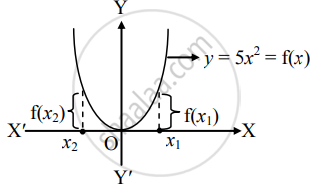
f(x) = 5x2 = y (say)
For two values (x1 and x2) of x, the values of the function are equal.
∴ f is not injective
∴ f does not have an inverse.
APPEARS IN
संबंधित प्रश्न
Let f : {2, 4, 5} → {2, 3, 6} and g : {2, 3, 6} → {2, 4} be given by f = {(2, 3), (4, 6), (5, 2)} and g = {(2, 4), (3, 4), (6, 2)}. Write down g ° f
Check if the following function has an inverse function. If yes, find the inverse function.
f(x) = 8
Check if the following function has an inverse function. If yes, find the inverse function.
f(x) = 9x3 + 8
Check if the following function has an inverse function. If yes, find the inverse function.
f(x) = `{(x + 7, x < 0),(8 - x, x ≥ 0):}`
If f(x) = `{(x^2 + 3, x ≤ 2),(5x + 7, x > 2):}`, then find f(0)
If f(x) = `{(4x - 2",", x ≤ -3),(5",", -3 < x < 3),(x^2",", x ≥ 3):}`, then find f(– 4)
If f(x) = `{(4x - 2",", x ≤ -3),(5",", -3 < x < 3),(x^2",", x ≥ 3):}`, then find f(– 3)
If f(x) = `{(4x - 2",", x ≤ -3),(5",", -3 < x < 3),(x^2",", x ≥ 3):}`, then find f(1)
If f(x) = `{(4x - 2",", x ≤ -3),(5",", -3 < x < 3),(x^2",", x ≥ 3):}`, then find f(5)
If f(x) = 4[x] − 3, where [x] is greatest integer function of x, then find f(7.2)
If f(x) = 2{x} + 5x, where {x} is fractional part function of x, then find `"f"(1/4)`
Solve the following for x, where |x| is modulus function, [x] is greatest integer function, [x] is a fractional part function.
|x − 4| + |x − 2| = 3
Solve the following for x, where |x| is modulus function, [x] is greatest integer function, [x] is a fractional part function.
|x| ≤ 3
Solve the following for x, where |x| is modulus function, [x] is greatest integer function, [x] is a fractional part function.
[x + [x + [x]]] = 9
Solve the following for x, where |x| is modulus function, [x] is greatest integer function, [x] is a fractional part function.
{x} = 0
Solve the following for x, where |x| is modulus function, [x] is greatest integer function, [x] is a fractional part function.
{x} = 0.5
Answer the following:
Find whether the following function is onto or not.
f : Z → Z defined by f(x) = 6x – 7 for all x ∈ Z
Answer the following:
Find whether the following function is onto or not.
f : R → R defined by f(x) = x2 + 3 for all x ∈ R
Answer the following:
Find composite of f and g:
f = {(1, 1), (2, 4), (3, 4), (4, 3)}
g = {(1, 1), (3, 27), (4, 64)}
Answer the following:
If f(x) = `(2x - 1)/(5x - 2), x ≠ 5/2` show that (f ° f) (x) = x
Answer the following:
Solve the following for x, where |x| is modulus function, [x] is greatest interger function, {x} is a fractional part function
|x2 − x − 6| = x + 2
Answer the following:
Solve the following for x, where |x| is modulus function, [x] is greatest interger function, {x} is a fractional part function
−2 < [x] ≤ 7
Answer the following:
Solve the following for x, where |x| is modulus function, [x] is greatest interger function, {x} is a fractional part function
[x2] − 5[x] + 6 = 0
Answer the following:
Solve the following for x, where |x| is modulus function, [x] is greatest interger function, {x} is a fractional part function
`[x/2] + [x/3] = (5x)/6`
Answer the following:
Find (f ° g) (x) and (g ° f) (x)
f(x) = ex, g(x) = log x
Answer the following:
Find f(x) if g(x) = x2 + x – 2 and (g ° f) (x) = 4x2 – 10x + 4
Answer the following:
Find (f ° f) (x) if f(x) = `(2x + 1)/(3x - 2)`
For f(x) = [x] , where [x] is the greatest integer function, which of the following is true, for every x ∈ R.
If f(x) =bx - 7 and f(-1) = 4, then b = ______.
If f(x) =x4, g(x) = 6x – 2, then g[f(x)] = ______.
If g(x) is the inverse function of f(x) and f'(x) = `1/(1 + x^4)`, then g'(x) is ______.
`int_0^3 [x]dx` = ______, where [x] is greatest integer function.
If z ≠ 0, then `int_(x = 0)^100` [arg | z |] dx is ______.
(where [.] denotes the greatest integer function)
Given, the function f(x) = `(a^x + a^(-x))/2 (a > 2)`, then f(x + y) + f (x − y) is equal to ______.
